Ask a general-purpose language model to design your operating model and it will produce something. It will be fluent, structurally plausible, and delivered with complete confidence. It will also be different tomorrow, unattributable to any source, and impossible to defend in a room where the decision matters.
For a first draft of a blog post, that trade is fine. For a decision that reorganises three thousand people, it is not a trade any responsible executive should make.
This is not an argument against AI in strategy work. It is an argument about where the intelligence should sit.
Two different machines
There is a fundamental architectural distinction that gets lost in the general enthusiasm.
A probabilistic system generates the next most likely token given everything before it. Its strength is coverage: it will produce something for any input. Its weakness is that the output is a sample from a distribution. Run it twice, get two answers. Ask why, and it will generate a plausible-sounding explanation — which is itself a sample, not a record of what actually happened.
A deterministic system applies defined operations to defined inputs and produces the same output every time. Its strength is that the output is reproducible and its derivation is inspectable. Its weakness is that it only covers what has been specified.
The interesting engineering question is not which is better. It is: which parts of strategy work belong to which machine?
What belongs where
In our architecture the answer is unambiguous, and it is the reason the system behaves differently from a chat interface.
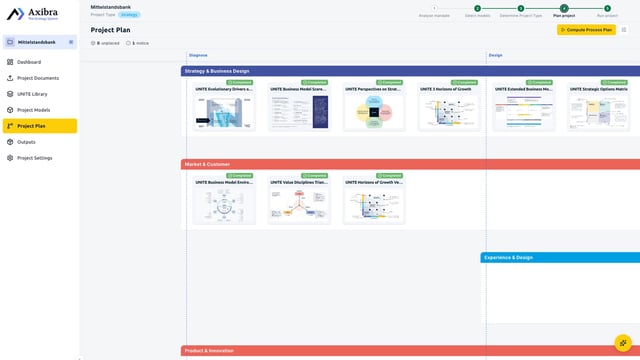
The core is deterministic. Which methods apply to this type of undertaking, how those methods decompose into phases and workstreams, what inputs each method requires, what its outputs feed into, how entities relate across the model — all of that is specified, not generated. It comes from the methodology corpus: 200+ UNITE Models, each an executable specification with defined inputs and outputs, developed over fifteen years of work with enterprises and validated in practice.
Language models handle what they are genuinely good at: reading unstructured input, drafting text into the structure the deterministic core has established, summarising, rephrasing. They fill in slots. They do not decide what the slots are.
The distinction matters most when something goes wrong. If a recommendation is questioned, a deterministic core can answer the question. Not with a generated justification — with the actual derivation: this method, applied to these inputs, referencing this source in the corpus.
The machine does the heavy lifting; people lead the judgement.
Why “just prompt it better” does not close the gap
The standard objection is that prompting, retrieval augmentation and larger context windows will eventually make the distinction irrelevant. We do not think so, for three reasons that are structural rather than temporary.
Reproducibility is not a quality property. A better model produces better samples. It does not produce the same sample twice. In a regulated decision context, “the model gave a different answer this time” is not a minor inconvenience; it is a disqualifying property.
Attribution cannot be retrofitted. You can ask a model to cite sources. What you get is a generated citation, which may or may not correspond to how the answer was actually produced. There is no mechanism inside a generative process that records derivation, because there is no derivation — there is sampling.
Coverage is not the constraint. The scarce resource in enterprise strategy work is not text. It is validated method applied correctly to a specific situation. A model that has read every strategy book ever written still has no way to know which of the ten thousand things it has read applies to your fourteen-entity regulatory programme, or why.
See a recommendation with its provenance attached
Every output names the model that produced it, the inputs it used and the assumptions it rests on. Bring a real question and check the trail yourself.
Book a demo20 minutes · with a strategist, not a sales repWhat this buys you in practice
Three properties, none of which is available from a generative system alone:
- Reproducible. The same undertaking, the same inputs, the same result. Two teams in two regions working the same problem produce comparable outputs, because they are running the same specification.
- Traceable. Every recommendation carries its method and its source. When the audit committee asks how a conclusion was reached, the answer is a record, not a reconstruction.
- Governable. Human decisions are documented as decisions. The system holds a record of how the decision was made, including who approved what — which is precisely what a system of record is for.
The honest limits
A deterministic core only covers what the corpus specifies. That is a real constraint and we state it plainly: the corpus is deep where undertakings are designed — strategy, business models, operating models, discovery, structuring the undertaking itself — and it is not a thin layer over everything an enterprise does.
The system will not run your marketing campaigns, your CRM pipeline or your code deployments. It hands your execution stack a traceable plan; it does not execute it. And it designs the operating model — the strategy-derived blueprint of how you will run — while wiring your actual IT architecture remains your architects’ craft.
We prefer that boundary stated up front. A system built for serious undertakings should be honest about its scope, because the failure mode of overpromising here is not a disappointed user. It is a bad decision made with false confidence.
The question worth asking vendors
If you are evaluating anything in this space, the useful question is not “does it use AI.” Everything uses AI now. The useful question is:
When your system makes a recommendation, can it show me the method that produced it and the source that method comes from — and will it produce the same recommendation tomorrow?
The answer to that question tells you which machine you are actually buying.
Book a working demo of Axibra
Not slides about the product — the product. Bring one real strategy decision; leave with a traceable artefact that still holds its reasoning three layers down.
Book a demoPrefer to look first? Apply for priority access →