The Strategy-to-Outcome Platform
Stefan F. Dieffenbacher
Founder & CEO, Digital Leadership AG
Most strategies never happen.
Not because the ambition was wrong, and not because the people were not good enough. They fail because the thinking behind them was never captured, never checked, and never carried through to the end. I have watched excellent work die in a folder more times than I can count.
I do not accept that this is simply how it is.
There is no school for the whole of this work. Excellence still sits inside single domains: strategy, design, business modelling, operations, structure, culture. The crossing is what nobody teaches. Most methods are one-trick ponies that stop at the edge of their own discipline, while a real initiative travels from customer needs to business models to operating models to organizational structure and culture.
What counts is a result strong in every domain and, above all, connected across them. That is what Axibra Results was built for: one integrated set of methods, easy enough that people actually use them.
I believe the purpose of all life is to evolve. For me that means developing people and organizations, and it is why we build Axibra Results for the world rather than for one market.
Let’s UNITE & create a world worth living in.
The research behind it
The hard part was never the writing.
Behind the platform are fifteen years of codified methodology. Before any of it became a book or a piece of software, it was a research programme, and the writing was not what took the time. Establishing the body of research underneath it was.
The goal was deliberately not to start from scratch. Where an established practice already worked, we integrated it: the published work draws on more than 600 sources – we quite literally stand on the shoulders of giants.
More than 60 co-creators worked on the body of knowledge itself, industry leaders, senior practitioners and researchers among them. They critiqued draft chapters, brought cases and examples, co-developed frameworks and reviewed them. Most spent days or weeks on it, several spent months or years.
Beyond them, more than 200 people contributed to and reviewed the individual models. Several models carry a research project of their own. The UNITE Culture Canvas and the UNITE Business Model Frameworks were each co-created with more than 30 people, and each took a year before it held.
None of it is one person’s opinion, and none of it is one firm’s house style. It was built by a few hundred people over years, with the published models downloaded over 100,000 times without a marketing budget.
Contributors are named in the book and listed at our contributors page.
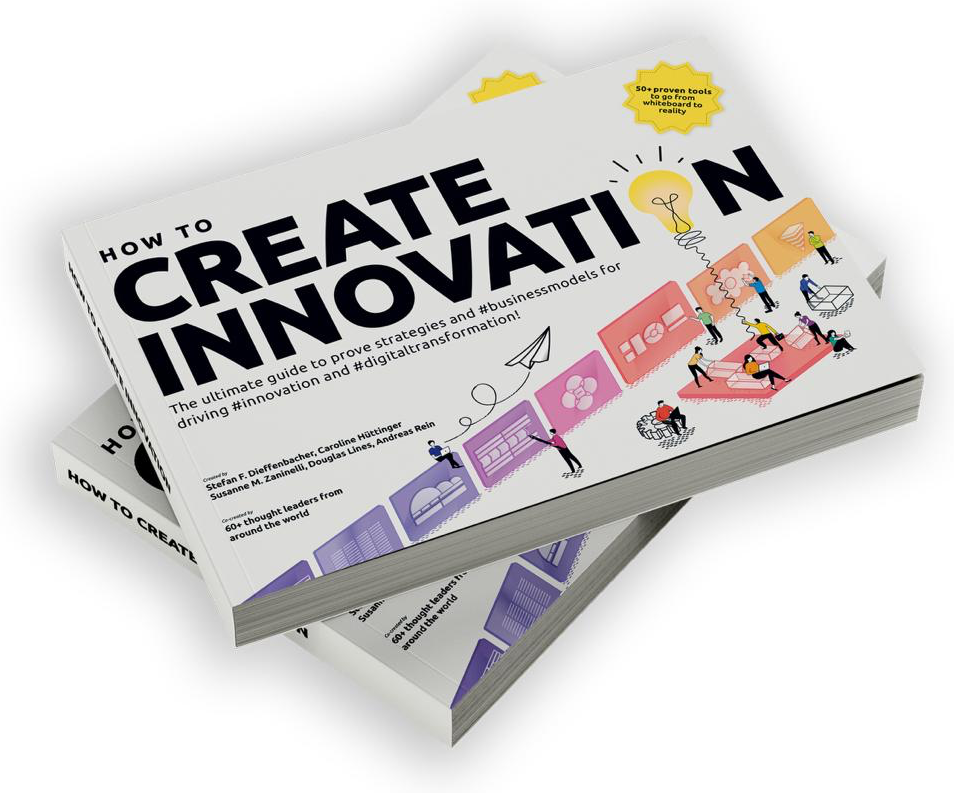
The book
“How to Create Innovation”
Wiley, 2024 · Chinese edition: China Industry & Commerce Press, Beijing, 2026
The book publishes part of the corpus: “How to Create Innovation” is building on the UNITE models. It covers the whole arc rather than one discipline, from the context and the foundations through the core innovation and transformation frameworks, organization and governance, culture, and business model innovation, and it closes with how to put all of it to work. This work will enable you to architect innovation across silos, and write your own story.
Co-authored by Caroline Hüttinger, Susanne M. Zaninelli, Douglas Lines and Dr. Andreas Rein.
Track record
Stefan has led large-scale international initiatives in enterprise innovation and transformation across almost every industry sector, and has built and invested in start-ups alongside them. The largest engagements include building up and managing a workforce of over 400 people, with a total amount invested of over €100 million.
Thirteen years living abroad, in eleven countries, with research and lectures at universities along the way.
Stefan F. Dieffenbacher holds an M.B.A.

Teaching and keynotes
Lectures and research at Ecole des Savignac, Frankfurt School of Finance, Heriot-Watt University Dubai, Hult International University Dubai, IE Madrid, Munich Business School, National Institute of Design (NID), NYU Stern School of Business, Strascheg Center for Entrepreneurship, Technical University of Munich (TUM), Tias Nimbas Business School, University of California Berkeley, and the University of Zürich.
Keynotes at AMC, Banking Club, Bitkom, Digital Mind Change, the European Design Thinking Conference, FI-TS Innovationstage, Forward Festival Berlin, Gartner, Henley Great Minds, i2 Summit, IFA Berlin, LEAP, LSZ government services, Mobile World Congress, OFFF, Pixel Festival, Roland Berger annual conference, Social Talk, SXSW, UX Strat Europe, WCF Davos, Web Summit, and the World Design Congress.
37 min · 2023
28 min · 2024
19 min · 2022
Next step
Bring a live initiative and the decision in front of you. The first conversation is with the people who wrote the method, not with a sales team.