Every large organisation has a moment it does not talk about. The strategy is signed off. The deck is good — genuinely good. The board is aligned. And then the work of turning it into something people can execute begins, and somewhere in that passage most of the precision quietly disappears.
Nobody decides to lose it. There is no meeting where a company agrees to discard the reasoning behind its own strategy. It happens structurally: the strategy lives in one artefact, the roadmap in another, the delivery plan in a third, and each translation is performed by different people using different tools, under time pressure, with no obligation to carry the reasoning forward.
We call this the translation loss. It is, in our experience, the single most expensive and least discussed failure mode in enterprise change.
Where exactly the loss happens
It is tempting to blame execution. Execution usually gets blamed. But the loss is not in execution — it is in the seams between artefacts.
Consider a market-entry strategy. The strategy work produces a where-to-play decision, an argument for why that market and not another, a set of assumptions that must hold, and a sequence of moves that depends on those assumptions. That is a rich object: decisions, reasoning, dependencies, conditions.
Now it becomes a roadmap. The roadmap keeps the moves and the sequence. It drops the reasoning and most of the conditions — a Gantt bar cannot hold an assumption. Then the roadmap becomes a delivery plan. The delivery plan keeps the tasks and the dates. It drops the moves as moves; they are now workstreams with owners.
By the time someone executes, they hold a task with a date. The reasoning that made the task the right task lives three artefacts upstream, in a file nobody on the delivery team opens. When conditions change — and they always change — nobody in the room can tell which tasks were downstream of the assumption that just broke.
Why it survives every attempt to fix it
Organisations do notice this. The usual responses are governance responses: more alignment meetings, a stricter PMO template, a transformation office whose job is to hold the thread.
These help, and they do not solve it, because they are all attempts to compensate for a structural gap with human effort. The thread is held by people who remember. When those people move on — and in a multi-year transformation they do — the thread goes with them. The organisation is left with the artefacts, and the artefacts do not contain the reasoning.
This is the honest reason so much change work underdelivers. It is not incompetence and it is not insufficient ambition. It is that the strategy and the execution of the strategy live in different systems, and no amount of meeting discipline makes two systems one.
What a single system actually means
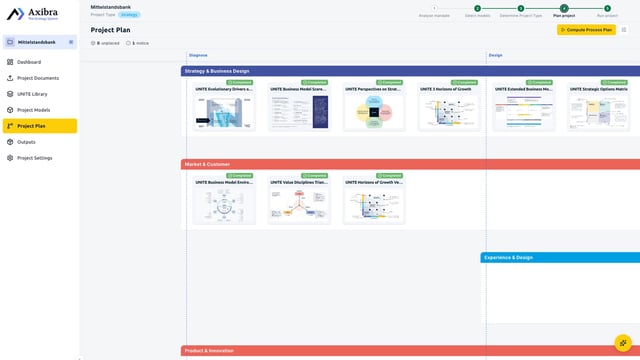
The alternative is not another tool that sits alongside the others. It is a data model in which the strategy, the roadmap and the delivery plan are the same object viewed at different resolutions.
In practice that means: a decision is an entity, not a bullet. It has a rationale, it references the method that produced it, it carries the assumptions it depends on, and the workstreams below it are linked to it rather than merely descended from it in a slide.
When that structure exists, three things become possible that are not possible with linked documents:
- Change propagates. When an assumption breaks, everything downstream of it is identifiable — not by memory, but by traversal.
- Reasoning survives handover. A new transformation lead inherits the argument, not just the plan.
- The plan stays alive. It is the thing you return to every week, because it is the only place where what comes next and why it comes next are the same record.
Strategy and execution are not two disciplines that need better coordination. They are one system that has been split by tooling.
Run one real decision through the system
Bring a live strategy problem — a market entry, a transformation case. We show it as one linked object: the decision, its rationale, the assumptions it depends on, and the workstreams underneath it.
Book a demo20 minutes · with a strategist, not a sales repThe uncomfortable implication
If the loss is structural, then the fix cannot be behavioural. You cannot workshop your way out of it. You can hire the best strategy team available and they will still hand over an artefact that drops most of what they knew.
This is why we built UNITE around a single data model rather than around better templates. The methodology corpus — 200+ UNITE Models, developed over fifteen years of transformation work and validated in practice — is not a library of documents. It is a set of executable specifications with defined inputs and outputs, which is what makes it possible for a strategy decision and a delivery workstream to be linked rather than merely related.
What to look for in your own organisation
You do not need a platform to diagnose the translation loss. Three questions usually settle it:
- Take any active workstream. Can someone on the delivery team name the strategic decision it descends from, and the reasoning behind that decision, without opening a file?
- Take any assumption in your current strategy. Can you list, in under a minute, every initiative that depends on it?
- Take any completed initiative. Can you reconstruct why it was scoped the way it was — not from someone’s memory, but from the record?
If the answers are no, no and no, the strategy is not the problem. The passage is.
Where this leads
The organisations that will handle the next decade well are not the ones with better strategies. Good strategy is more available than it has ever been. They are the ones that can carry a strategy through to execution without losing the reasoning on the way — and, when the world moves, can tell within a day rather than a quarter what that movement invalidates.
That is a systems property, not a talent property. It is buildable.
Book a working demo of Axibra
Not slides about the product — the product. Bring one real strategy decision; leave with a traceable artefact that still holds its reasoning three layers down.
Book a demoPrefer to look first? Apply for priority access →