Most organisations still speak about transformation as if it were a project: it starts, it runs, it finishes, there is a closing steering committee and a lessons-learned deck. This framing survives because it is administratively convenient. It is also, at this point, simply wrong.
In every established organisation we work with, change is not an event. It is a permanent operating condition, and it runs on at least three tracks simultaneously — each with different owners, different cadence, different risk profiles, and different methods.
Confusing them is expensive. Applying the governance of one horizon to the work of another is one of the more reliable ways to make good people fail.
Horizon 1 — change in the running business
This is the broad, recurring change work every unit carries: process redesign, structural improvement, efficiency programmes, continuous improvement portfolios.
It is unglamorous and it is enormous. In headcount terms it is usually the largest category of change work in the organisation, and it is almost never described as “transformation” by the people doing it. They describe it as their job.
The failure mode here is method starvation. Because the work is routine, nobody assigns methodological support to it. A process owner running their fourth redesign in three years improvises the approach each time, not because they lack capability but because the method is not available to them at the moment they need it.
Horizon 2 — transformation of the existing
Here the object is what already exists: the business model, the operating model, the organisation itself. Business model renewal. Operating model design. Regulatory transformation. Post-merger integration.
This is the horizon that gets the word “transformation” attached to it and the budget that comes with the word. It is also the horizon with the highest coordination burden, because the work crosses every functional boundary in the company at once.
The failure mode is fragmentation. Fourteen legal entities, four jurisdictions, a fixed regulatory deadline — and each stream structures its work differently because each stream has a different lead with a different background. The programme then spends a large share of its energy on internal translation rather than on the change itself.
Horizon 3 — innovation and new business
What does not exist yet: innovation strategy and portfolio, product and service discovery, new business models.
Different economics, different tolerance for failure, different methods entirely — Jobs-to-be-Done, Design Thinking, business model patterns. Most importantly: a different definition of success. Horizon 1 succeeds by reducing variance. Horizon 3 succeeds by finding the one option in twenty that works.
The failure mode is governance transplant. Horizon 3 work assessed with Horizon 1 controls dies quickly and quietly. Every organisation that has ever run an innovation lab under standard capex governance has watched this happen.
Run one real decision through the system
Bring a live strategy problem — a market entry, a transformation case. We show it as one linked object: the decision, its rationale, the assumptions it depends on, and the workstreams underneath it.
Book a demo20 minutes · with a strategist, not a sales repAll three run at once
The point is not that these are stages. They are not a maturity ladder and they do not happen in sequence. They run in parallel, permanently, in the same organisation, often in the same business unit, sometimes with the same people involved in all three in the same week.
This is what makes change work structurally hard in a way that individual projects are not. The organisation does not need to be good at one kind of change. It needs to be good at all three simultaneously, and it needs to be able to tell them apart.
Transformation is a condition, not a programme with an end date.
What the horizons share
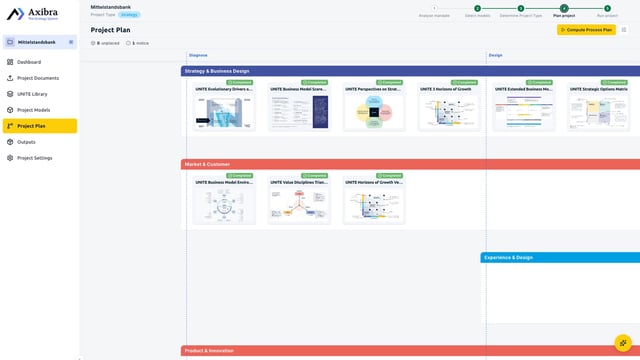
Despite the differences, every undertaking across all three horizons goes through the same skeleton: it has a type, it decomposes into phases, and the phases decompose into workstreams. The type determines which methods apply. The methods determine what the phases actually contain.
That is a mechanical statement and it is the basis of everything we build. If the structure is common, it can be systematised. What differs by horizon is which methods the engine applies — not whether the undertaking can be structured at all.
Give the engine a brief — “regulatory transformation, fourteen legal entities, four jurisdictions, deadline Q1 2027” — and it returns the project workflow with the applied methods filled in, each traceable to its methodological source. The same mechanism serves a Horizon 1 process redesign and a Horizon 3 business model exploration, drawing on entirely different parts of the corpus.
Practical consequences
Three things follow if you take the three-horizon view seriously.
Stop running one governance model. If your investment committee applies the same evidence standard to a Horizon 3 discovery as to a Horizon 1 efficiency programme, you are systematically killing your innovation portfolio and over-tolerating your efficiency portfolio.
Assign method deliberately. Horizon 1 is where method support is most absent and where the aggregate value of providing it is largest, precisely because the volume is so high.
Count the whole portfolio. Most organisations can list their Horizon 2 programmes. Very few can list the Horizon 1 change work happening across their units. That work consumes real capacity, and it is invisible to the transformation office.
The capability question
If change is permanent and runs on three tracks, then the relevant question is not “how do we run this transformation.” It is: what capability does an organisation need so that any undertaking, in any horizon, can be structured, staffed with the right methods, and carried to a governed plan — repeatedly, without heroics?
That is a capability question, and capability questions have systematic answers.
Book a working demo of Axibra
Not slides about the product — the product. Bring one real strategy decision; leave with a traceable artefact that still holds its reasoning three layers down.
Book a demoPrefer to look first? Apply for priority access →