Every significant piece of change work starts the same way: someone describes what needs to happen, in a sentence or two, usually in a meeting.
“We need to consolidate the European entities before the new regulation lands.” “We have to decide whether to enter the mid-market segment and how.” “The operating model does not support the new business — redesign it.”
And then there is a gap. Between that sentence and the first genuinely productive piece of work, weeks pass. Someone drafts a scope. Someone else proposes a structure. There are workshops about how to run the workshops. A steering committee approves a plan that is mostly a list of phases with dates and no methodological content.
This gap is so normal that most organisations do not perceive it as waste. It is simply how programmes start.
What is actually happening in those weeks
Three distinct things, tangled together.
Type classification. What kind of undertaking is this? Regulatory transformation and market entry are different animals with different structures, and the classification determines almost everything downstream. This usually happens implicitly, in someone’s head, and is never written down.
Decomposition. The undertaking breaks into phases; phases break into workstreams. Most of the visible planning effort goes here, and most of it is reconstruction — organisations re-derive a structure that closely resembles one they built two years ago for a comparable undertaking.
Method assignment. Which methods apply to which workstream. This is where the real expertise sits and it is the part that most often does not happen at all. Workstreams get owners and deadlines; whether the owner has the right method is left to the owner.
The weeks are consumed almost entirely by the first two, which are the most repeatable parts, while the third — the part that determines output quality — gets the least attention.
The step nobody automates
Here is the observation that shaped our architecture: this classification-and-decomposition step is systematic, and no adjacent category of software performs it.
Project tools take a structure you already have and track it. Strategy tools give you canvases to fill in. Consulting gives you people who perform the step in their heads, at their day rate, and take the reasoning with them when the engagement ends.
Nothing takes a brief and returns the structured undertaking.
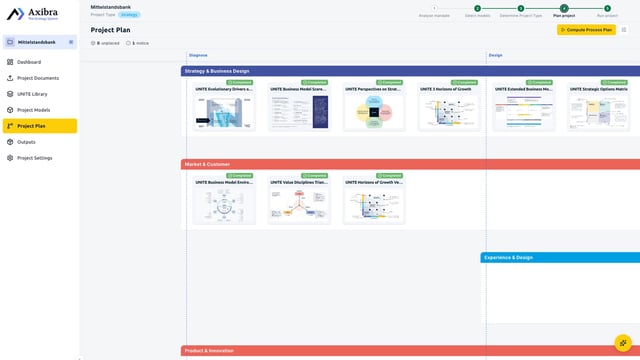
That is what a methodology corpus makes possible — but only if the methods are executable specifications with defined applicability conditions rather than documents. Then classification becomes: which undertaking type do these characteristics match. Decomposition becomes: what phase structure does that type imply. Method assignment becomes: which methods declare themselves applicable to these workstreams.
The brief goes in. The workflow and the applied methods come out.
Concretely
Take a real brief: “Regulatory transformation, fourteen legal entities, four jurisdictions, deadline Q1 2027.”
Four characteristics, each of which carries structural implications. Regulatory transformation implies a compliance-driven phase structure with fixed external gates. Fourteen entities implies a rollout dimension and an entity-level readiness question. Four jurisdictions implies parallel legal tracks that cannot be merged. A fixed deadline implies backward planning from the gate and a critical path that runs through the slowest jurisdiction.
An experienced programme director derives all of that in about an hour, if they have run this type before. The engine derives it from the specification — and, more importantly, derives the methods: which assessment method for entity readiness, which method for the jurisdictional gap analysis, which for the target-state design.
What comes back is not a plan template. It is the project workflow with the applied methods filled in, each traceable to its methodological source. The programme director then does what they should be doing: challenging the structure, adjusting for what the engine cannot know, and deciding.
Run one real engagement through the system
Take a live case — a brief, an RFP, a delivery plan. We show how the method structures it end to end, so the reasoning survives the handover to the next team.
Book a demo20 minutes · with a strategist, not a sales repWhy fifteen years of methodology work matters here
The reason this is possible is unromantic: the corpus was built by running real undertakings, not by cataloguing frameworks.
Fifteen years of transformation work across a large number of enterprises produces something specific — not just methods, but the applicability knowledge around them. Which method works when the organisation lacks a central methodology function. Which sequence fails when the regulatory deadline is inside twelve months. What has to be true before a business model method produces anything useful.
That knowledge is what turns a library into an engine. Real undertakings, in this sense, are real briefs: each one taught the corpus something about which methods fit which situations.
What it changes
Three things, in order of how quickly organisations notice them.
The weeks come back. The structuring phase compresses from weeks to a working session. This is the visible benefit and the least interesting one.
Structure becomes comparable. Every undertaking of the same type is structured the same way. Portfolio-level questions — where are we across all our Horizon 2 work, which programmes share a dependency — become answerable, because the underlying structures are commensurable rather than bespoke.
Method reaches the work. This is the one that compounds. The workstream owner who would otherwise have improvised now has the applicable method, with defined inputs and outputs, at the moment they need it. Across a portfolio of dozens of undertakings, that is the difference between an organisation that runs on leading practice and one that runs on whoever was available.
The honest caveat
The engine structures the undertaking. It does not run it, and it does not know your organisation’s politics, its history, or which of the fourteen entities has a country manager who will resist.
That is the work of the person leading. What changes is what they are leading with: a structured, method-grounded plan produced in a session, rather than a phase list produced over six weeks.
Book a working demo of Axibra
Not slides about the product — the product. Bring one real strategy decision; leave with a traceable artefact that still holds its reasoning three layers down.
Book a demoPrefer to look first? Apply for priority access →