Here is a finding from fifteen years of transformation work that consistently surprises the people it describes: even very senior practitioners know only around ten methods really well.
Not ten they have heard of. Ten they can run under pressure, on a real undertaking, with a difficult stakeholder in the room, without looking anything up.
That number holds remarkably steady across seniority. Partners at major firms, heads of internal consulting, twenty-year transformation veterans — the working repertoire is roughly a dozen methods, deployed with genuine skill, plus a much longer list they could describe but would not confidently lead.
This is not a criticism. It is what mastery costs. Getting to real fluency in a method takes repeated application across varied contexts, and there are only so many undertakings in a career.
Why this is a structural problem
If individual repertoires cap at ten, and the useful method space is measured in hundreds, then the gap is not a training gap. It is arithmetic.
Three consequences follow, and every organisation exhibits at least two of them.
Method selection collapses to familiarity. Faced with a new undertaking, people reach for what they know. The chosen method is often adequate and occasionally wrong, and there is no moment in the process where a better-fitting method could have surfaced, because nobody in the room knows it exists.
Quality varies by who is assigned. Five people doing “segmentation” produce five approaches, each reflecting the repertoire of whoever leads. The outputs are not comparable, which means the organisation cannot aggregate learning across undertakings.
The repertoire walks out. When a senior practitioner leaves, their ten methods leave. The organisation retains documents that describe methods and loses the ability to run them well.
The usual responses, and why they underperform
Training. Organisations invest heavily here, and it does move the needle — from ten methods to perhaps twelve. It does not change the structure, because the constraint is application opportunity, not instruction.
Method libraries. An intranet with two hundred frameworks. Usage data on these libraries is consistently disappointing, for a simple reason: a library helps if you know which method you need. The failure mode is not being unable to find the method. It is not knowing it applies.
Hiring specialists. Effective for the specific gap it fills, and unaffordable across two hundred methods. This is also the mechanism that keeps external consulting expensive: you are renting a repertoire.
What actually changes the arithmetic
Reframe the problem. If individual working knowledge caps at around ten, the question is not how to raise the cap. It is how to make the system’s repertoire larger than any individual’s — while keeping the individual in charge of judgement.
That requires three things, and all three have to hold:
- The method space has to be navigable by problem, not by name. The practitioner does not know which method they need. They know what undertaking they are facing. The system has to make that step — from situation to applicable methods — rather than expecting the user to make it.
- Methods have to be executable, not just described. A method that returns a PDF has moved the problem, not solved it. A method that takes structured inputs and produces structured outputs can actually be run by someone who has not mastered it.
- Judgement has to stay human. The practitioner still decides. What changes is that they decide on well-formed options produced by the right method, rather than on whatever their repertoire happened to contain.
What organisations need is guidance through a method system whose size exceeds any individual’s working knowledge.
Run one real engagement through the system
Take a live case — a brief, an RFP, a delivery plan. We show how the method structures it end to end, so the reasoning survives the handover to the next team.
Book a demo20 minutes · with a strategist, not a sales repWhat this looks like in practice
A transformation lead faces a post-merger integration. Their repertoire contains three methods relevant to PMI, all learned in a previous role at a different scale.
In the current model, they run those three, competently, and the parts of the undertaking those methods do not cover get handled by improvisation and meeting time.
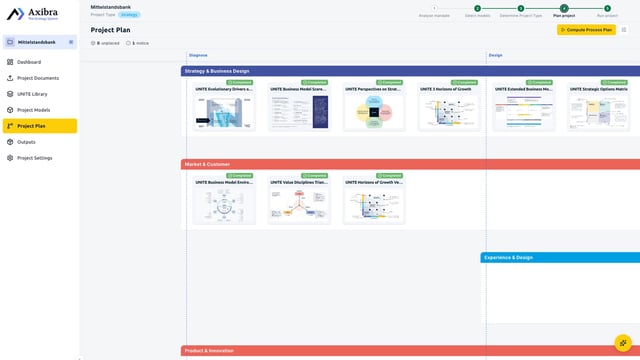
In the model we build toward, they describe the undertaking. The engine determines the type, decomposes it into phases and workstreams, and applies the methods that fit — including several the lead has never run, each producing structured output that connects to the next step. The lead reviews, challenges, adjusts and decides. Their judgement is fully engaged; their repertoire is no longer the ceiling.
The difference is not that the person becomes less important. It is that the ten methods they know deeply are now applied where judgement is scarce, rather than being stretched to cover work they were never the right tool for.
The organisational payoff
At individual level this looks like productivity. At organisational level it is something different: consistency.
When methods are applied because they fit rather than because they were known, two undertakings of the same type get comparable treatment. Outputs become aggregable. Learning accumulates in the system rather than in individuals. And the quality floor — the worst output the organisation produces in a given month — rises sharply, which in aggregate matters more than raising the ceiling.
Testing it in your own organisation
Ask five senior people, independently, to list the methods they would confidently lead on a live engagement tomorrow.
Two things usually emerge. The lists are short. And they overlap much less than anyone expects — which means your organisation’s effective repertoire is fragmented across individuals, available only to whichever undertaking happens to draw the right person.
That is the constraint. It is not fixable by training and it is not fixable by hiring. It is fixable by making the method system larger than the people who use it.
Book a working demo of Axibra
Not slides about the product — the product. Bring one real strategy decision; leave with a traceable artefact that still holds its reasoning three layers down.
Book a demoPrefer to look first? Apply for priority access →