Culture and organization
Culture is the first reason transformations fail. Axibra keeps the organizational side of a decision in view instead of leaving it to chance.
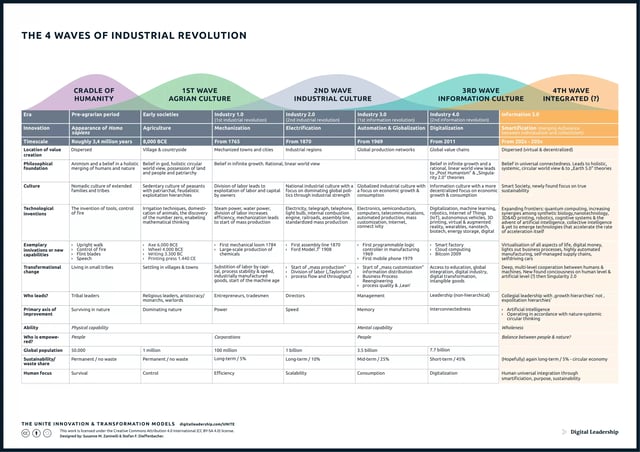
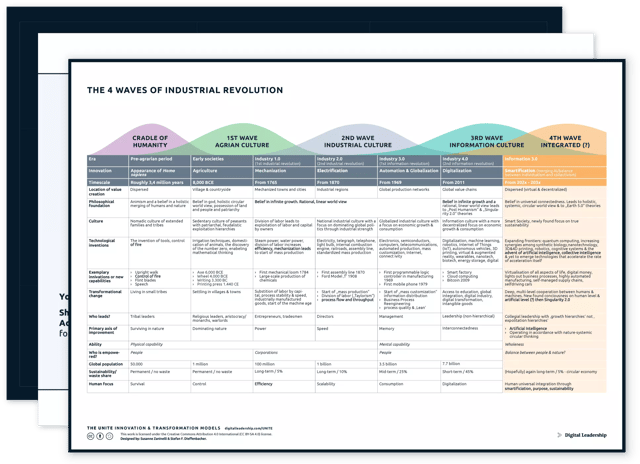
See how it worksThis ground-breaking model outlines the four waves of industrial and cultural revolution that human civilization has undergone over its history, breaking down the most critical factors for each period.
The package
The case
We are far beyond what we think of as the Industrial Revolution, in fact we are in the midst of a third wave, an information revolution. Regardless of your sector, it is impossible to ignore the power of data and digital technologies. This model helps you see the ways in which cultural and industrial revolutions have shaped our societies over time. It also helps you understand the interconnected nature of industry and culture and provides a glimpse into what may lay ahead of us.
The mechanics
Human development has proceeded in a series of waves that we call cradle, agrarian, industrial, informational, and integrated. Of course, like a wave, a change in the mode of value creation doesn’t alter everything at the snap of a finger. In fact, all of the waves coexist right now across the world, sometimes even within the same society or business. For the purposes of analysis, however, we can divide them into somewhat distinct periods. Often, changes in human organization are driven by new technologies. For instance, humans developed the ability to grow crops and raise livestock, sparking the agrarian revolution. Then they harnessed the power of fossil fuels with the steam engine and electric generator, sparking the industrial revolution. As each of these technological changes happened, however, it led to deeper changes in how we saw ourselves and the world around us, creating new movements in thought, politics, economics and culture. We also developed new values and new goals. In the last 50 years, we have moved from a world powered by fossil fuel to a world powered by information. This information revolution has increased the rate of acceleration; it is now happening at breakneck speed. And yet, from a cultural perspective, people are beginning to realize that the demarcation between self and collective is false. As we move into an integrated world, we see these differences fall away, and we envision an economy and society that integrates the needs of the individual with the needs of society and of the planet.
The purpose
What is the goal of the model?
Changing your mindset: The tools, technologies and approaches that worked 20 or even 10 years ago, will no longer ensure future success. Understanding the ways in which industry, business and culture has evolved helps you understand that change is the only constant. The 4 Waves of Industrial Revolution helps you envision a different path for your company, a path of innovation.
Beyond the download
The PDF is yours to keep. But a model changes something only when it touches the work — and that is what Axibra does with it. The model becomes the structure your decisions are made in, and every outcome stays traceable back to the input it came from.
In practice
For years we applied this model by hand, in client engagements. It now runs inside Axibra.
Culture is the first reason transformations fail. Axibra keeps the organizational side of a decision in view instead of leaving it to chance.
See how it worksThousands of organizations leverage the UNITE models — these are some of them …













By subject

From here on
Axibra is where these models run. It carries a decision through to the work that follows it, and keeps every result traceable back to the input it came from. If you would rather start with a conversation, we are one call away.
Strategy does not fail in the thinking. It fails in the handover.
Stefan F. DieffenbacherFounder & Managing Director of Digital Leadership