Ask a consulting partner what the firm’s most valuable asset is and you will hear some version of: our people, our methods, our client relationships.
The first and third are honest. The second is aspirational, and the gap between the claim and the reality is where a great deal of firm value quietly fails to accumulate.
Because in most firms, the methodology is not an asset. It is a set of habits distributed across partners’ heads, partially documented, inconsistently applied, and fully portable — it leaves when they leave.
Three symptoms
You can diagnose this without access to the books. Three symptoms show up in every firm where methodology has not been made into an asset.
The partner bottleneck. A large share of partner time goes into proposal construction, methodology setup and quality assurance rather than client judgement and relationship work. Revenue capacity is therefore capped by partner hours, and the cap is hard: adding juniors does not raise it, because juniors increase the review burden.
The junior productivity gap. Associates take somewhere between two and three years to reach full self-sufficiency. During that period the firm subsidises their learning, and the learning happens by osmosis — sitting next to someone who knows, absorbing method by observation. It works, slowly, and it is the most expensive training mechanism ever devised.
Methodology variance. Five partners running “segmentation” produce five approaches. Each is defensible. None is comparable to the others. The firm cannot aggregate learning across engagements, cannot make quality claims that hold across teams, and re-derives its own method on every engagement.
None of these are signs of a badly run firm. They are the default state of professional services, and firms compensate for them with heroics — senior people working very hard to hold quality up.
Keeping quality high is heroic work. Heroics do not scale.
What “asset” would actually mean
An asset has three properties the current arrangement lacks: it persists independently of individuals, it can be deployed by people who did not create it, and it appreciates with use rather than depreciating with turnover.
Applied to methodology, that means:
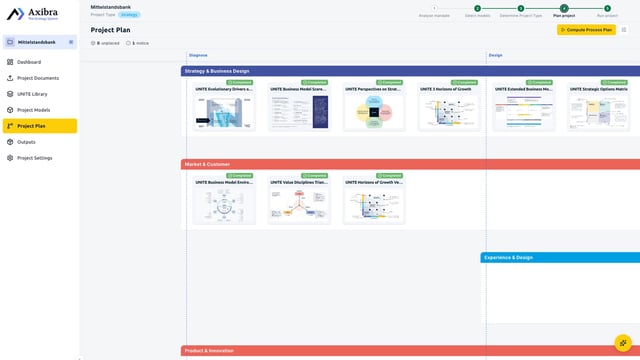
- The method exists outside anyone’s head, in a form precise enough to be executed rather than merely read.
- A consultant who has never run the method can run it competently, with the firm’s quality standard built in.
- Every engagement that uses it feeds back into it — refinements accumulate rather than dispersing.
Firms have attempted this for decades with knowledge management systems, and the results are famously poor. Not because the ambition was wrong, but because the artefact was: a document describing a method does not satisfy any of the three properties. It persists, but it cannot be executed, and it does not improve.
Five levers, one of which matters most
When a firm’s methodology becomes executable rather than descriptive, the effects compound across five distinct levers.
| Lever | Mechanism |
|---|---|
| Partner leverage | Proposal and methodology setup shift to the system — partners carry more engagements with the same hours |
| Junior productivity | The methodology available on demand from day one, rather than absorbed over years |
| Consistency | One definition per model, leading practices applied every time |
| Full-lifecycle continuity | Sales, strategy and implementation in one system — no translation loss between phases |
| Methodology as an asset | The codified method becomes a firm asset that compounds |
Each lever on its own is modest. Together they change the economics of the firm, and the second one — junior productivity — is the lead lever in almost every case we have modelled with firms.
The reason is structural. The junior cohort is the largest population, the productivity gap is the longest-duration inefficiency, and the improvement applies to every engagement rather than to a subset. A partner-leverage improvement helps at the top of the pyramid. A junior-productivity improvement changes the shape of the pyramid.
Run one real engagement through the system
Take a live case — a brief, an RFP, a delivery plan. We show how the method structures it end to end, so the reasoning survives the handover to the next team.
Book a demo20 minutes · with a strategist, not a sales repThe objection that matters
Every serious conversation with a firm reaches the same question, usually about twenty minutes in: if the method is in the machine, what is the partner for?
It is the right question and it deserves a direct answer.
The machine does the heavy lifting: structuring the undertaking, applying the methods, producing the analysis and the artefacts. What it does not do is judgement — reading the client’s politics, knowing which of three defensible recommendations this particular board will actually execute, deciding when the method’s answer is wrong for reasons the method cannot see.
That is the partner’s craft and it is not automatable, because it is not codifiable. What is automatable is everything the partner currently does that is not that: the setup, the structuring, the review of work that should not have needed reviewing.
Firms that adopt this well end up with partners doing more of what partners are actually for. The output is client-ready; the judgement is theirs.
Post-merger, the case is sharper
For firms that grow by acquisition, the methodology question is not an efficiency question — it is an integration question.
Acquire a firm and you acquire a second methodology, a second set of tools, a second delivery standard. The standard integration playbook addresses systems, brand and compensation, and leaves the methodological merge to happen socially, over years, incompletely.
When methodology is codified and executable, the merge becomes a real project with a real endpoint: reconcile two corpora into one, resolve conflicting definitions, deploy. That is hard work, but it is finite work — which is more than can be said for hoping two cultures converge on a shared approach to segmentation.
Where to start
Not with the whole corpus. The firms that get traction start with one engagement type — the one they sell most often — and codify that properly, end to end, on a live pursuit with real success criteria agreed in advance.
The value of starting narrow is not risk reduction. It is that a single engagement type run properly through the system produces the firm’s own numbers, on the firm’s own work. Every subsequent conversation about scaling is then a conversation about evidence rather than about promise.
Book a working demo of Axibra
Not slides about the product — the product. Bring one real strategy decision; leave with a traceable artefact that still holds its reasoning three layers down.
Book a demoPrefer to look first? Apply for priority access →