Innovation
Axibra helps organizations grow their innovation capability — across the whole company, not in one team.
See how it worksThe Customer Promise Canvas allows you to spin your most significant innovation opportunities into initial solutions and rank these. Further, we test the identified solutions against your business capabilities and the customer’s needs.
The package
The case
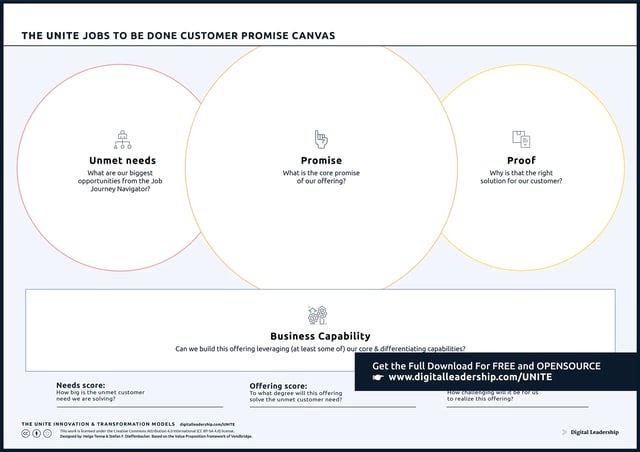
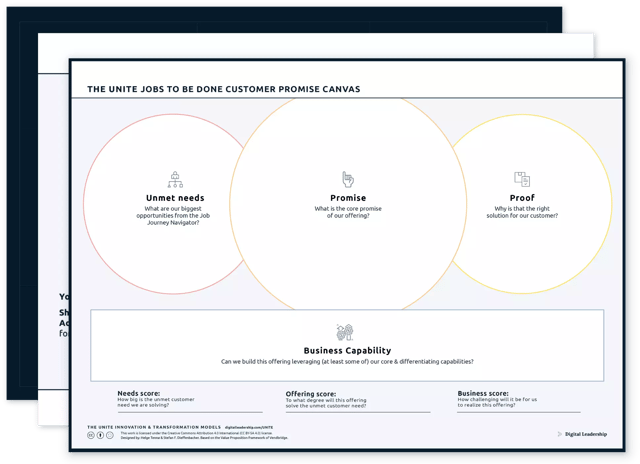
Just because a customer has a substantial unmet need doesn’t mean that you have the right solution. The UNITE Customer Promise Canvas allows you to connect customer needs to your business by outlining promises you are capable of making to your customers about how to solve their problem and then ranking those promises to find the most promising one.
The mechanics
The UNITE Customer Promise Canvas begins, as innovations always should, with your customer’s need. The Unmet Needs box covers your biggest opportunities from your Job Journey Navigator. Next, you make a Promise to the customer in the form of a solution that will be the basis of your Value Proposition. What are you going to build to meet their need? The third step is Proof. Here is where testing and verification come in. How can you prove that this solution is the right one for the problem and that it will actually work? Finally, we need to think about Business Capabilities. Is your business realistically capable of producing this solution successfully and at scale? Think about your core and differentiating capabilities and ask yourself whether these will enable you to produce this product or solution more effectively than your competitors.
The purpose
What is the goal of the model?
Turn your customers’ needs into solutions that stick. The UNITE Customer Promise Canvas helps you turn the important but unmet customer needs into initial solutions that you can then rate to identify the best ones. It also helps you understand whether you can actually realize your idea. The only thing worse than a problem with no solution is a promised solution that is not delivered. Make sure you have the right solution and that it’s the right move for your company.
Beyond the download
The PDF is yours to keep. But a model changes something only when it touches the work — and that is what Axibra does with it. The model becomes the structure your decisions are made in, and every outcome stays traceable back to the input it came from.
In practice
For years we applied this model by hand, in client engagements. It now runs inside Axibra.
Axibra helps organizations grow their innovation capability — across the whole company, not in one team.
See how it worksAxibra helps you understand your customers better and design products and services people actually want to use.
See how it worksAxibra closes the infamous gap between strategy and execution, and carries a transformation through to delivery.
See how it worksThousands of organizations leverage the UNITE models — these are some of them …












By subject

From here on
Axibra is where these models run. It carries a decision through to the work that follows it, and keeps every result traceable back to the input it came from. If you would rather start with a conversation, we are one call away.
Strategy does not fail in the thinking. It fails in the handover.
Stefan F. DieffenbacherFounder & Managing Director of Digital Leadership