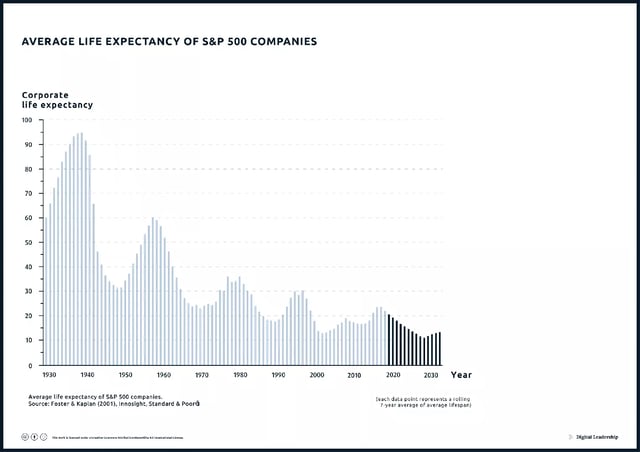
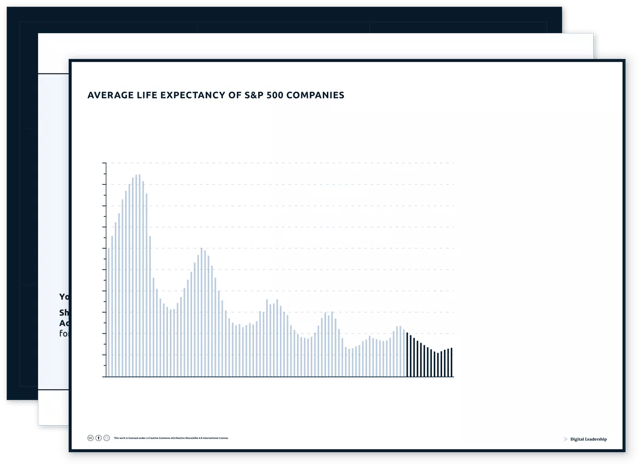
A visual depiction of the decreasing lifes expectancy of companies based on data from Standard and Poor’s.
The package
The case
The average lifespan of companies has been falling dramatically over the past 100 years. Both external and internal factors are fueling this change. Understanding this fact clarifies the need for a company to continually reinvent itself.
The mechanics
In the past, companies lasted for a human lifetime. By 1964, the average life expectancy of a company on the S&P 500 had fallen to 33 years. By 2014 it had shrunk to 22 years, and it is supposed to fall to 12 by 2027. This means that we can no longer plan in ten-year blocks. As technology accelerates, your company needs to be thinking about how to continually look for opportunities for growth and innovation. This may mean moving into adjacent fields or spinning off a separate company to fulfill a customer’s unmet need. Or it may mean taking a hard look at your business and thinking about how you can disrupt yourself. Regardless, you don’t have the option of resting on your laurels. If you want to survive, you’ve got to keep moving.
The purpose
What is the goal of the model?
“Understanding that the life expectancy of companies is falling dramatically is just the first step”. The biggest driver of this shortening lifespan is technological disruption which is expected to further accelerate. That means you can no longer optimize your business and put it on autopilot. You need to reinvent yourself every decade, if not sooner. The best way to achieve this is to use the 3 Horizons of Growth as a framework, conduct portfolio allocation based on the 3 Horizons, and take bold steps to start on a continuous journey of transformation and innovation.
Beyond the download
The PDF is yours to keep. But a model changes something only when it touches the work — and that is what Axibra does with it. The model becomes the structure your decisions are made in, and every outcome stays traceable back to the input it came from.
Thousands of organizations leverage the UNITE models — these are some of them …













By subject
From here on
Axibra is where these models run. It carries a decision through to the work that follows it, and keeps every result traceable back to the input it came from. If you would rather start with a conversation, we are one call away.
Strategy does not fail in the thinking. It fails in the handover.
Stefan F. DieffenbacherFounder & Managing Director of Digital Leadership