Culture and organization
Culture is the first reason transformations fail. Axibra keeps the organizational side of a decision in view instead of leaving it to chance.
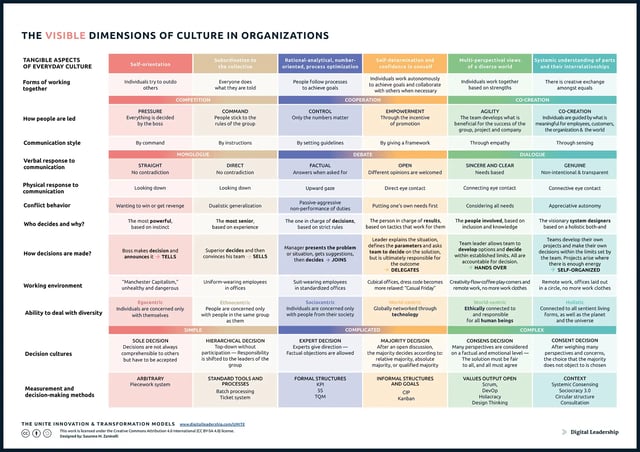
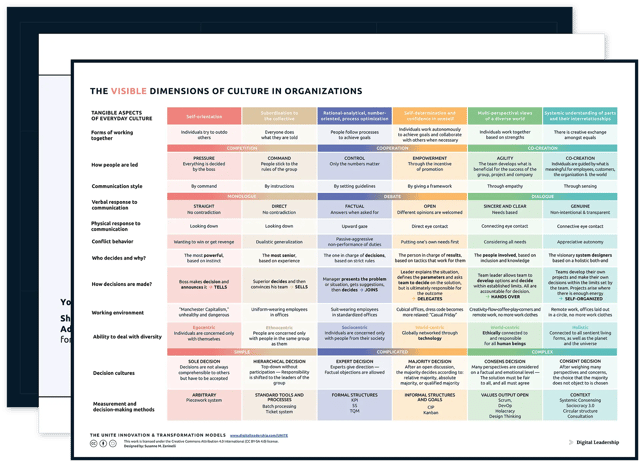
See how it worksOne of the values of the Mindset Spectrum is that it is a tool that helps us see the big picture and all of the minute details of our organization. It’s like a telescope, and a microscope rolled into one. So here we use it to outline how different mindsets influence specific aspects of your organization, both the obvious and the not-so-obvious ones.
The package
The case
Mindset influences all the parts of our organization, the visible and the invisible. When we begin to think about how to design the culture we want, we begin by assessing the culture that we have. In order to do that, we need to be able to think deeply (and honestly) about our values, perceptions, feelings and goals. The breakdown of the visible and invisible dimension of culture help us do just that.
The mechanics
The Mindset Spectrum moves from self-orientation (red) to subordination to the collective (beige) to analytical optimization (blue) to self-determination (orange) to embracing multiple perspectives on the world (green) and finally to a systemic understanding of parts and their relationship to the whole and to each other (teal). Unsurprisingly, these mindsets manifest in very different ways when it comes to the specifics of your organization. For instance, in the case of decision-making, a red mindset leads to hierarchical structures in which the one superior makes decisions and tells others what they are, whereas in an orange mindset, the leader of a group may let the group decide after having communicated the parameters of it, however still remains responsible for the decision. In a teal culture, parameters are set, and the group makes decisions collectively. There is no longer the need for the attribution of responsibility because the teal group sees decisions as experiments that will be assessed and altered if necessary.
The purpose
What is the goal of the model?
An honest assessment of where we are. To figure out how to get where we want to go, we need to understand where we are starting. So our first step in creating an innovation culture will be to outline the mindset that drives our current culture, so that we can think about how to bridge the gap between our aspirations and our reality.
Beyond the download
The PDF is yours to keep. But a model changes something only when it touches the work — and that is what Axibra does with it. The model becomes the structure your decisions are made in, and every outcome stays traceable back to the input it came from.
In practice
For years we applied this model by hand, in client engagements. It now runs inside Axibra.
Culture is the first reason transformations fail. Axibra keeps the organizational side of a decision in view instead of leaving it to chance.
See how it worksThousands of organizations leverage the UNITE models — these are some of them …













By subject

From here on
Axibra is where these models run. It carries a decision through to the work that follows it, and keeps every result traceable back to the input it came from. If you would rather start with a conversation, we are one call away.
Strategy does not fail in the thinking. It fails in the handover.
Stefan F. DieffenbacherFounder & Managing Director of Digital Leadership