Culture and organization
Culture is the first reason transformations fail. Axibra keeps the organizational side of a decision in view instead of leaving it to chance.
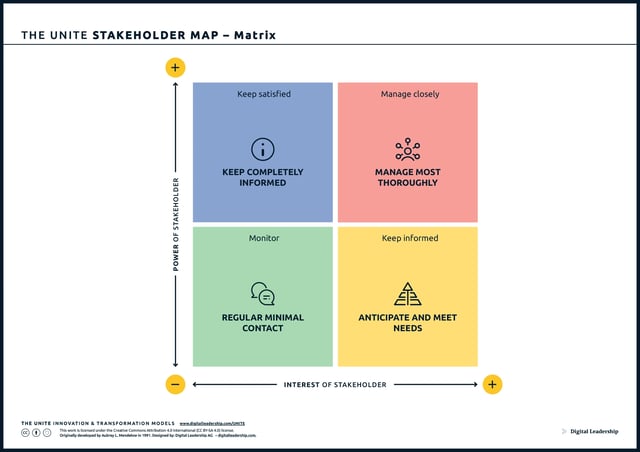
See how it worksThe UNITE Stakeholder maps help you understand the different perspectives and needs of stakeholders, and to develop strategies for engaging and managing them effectively.
The package
The case
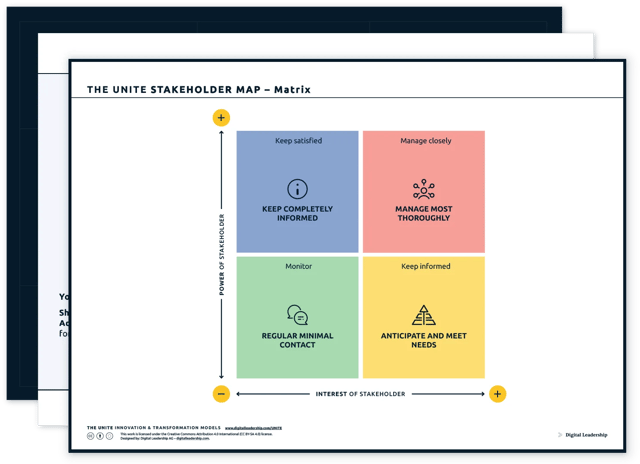
Our projects and decisions can have effects we don't consider early on. Stakeholder mapping is used to understand the different perspectives and needs of stakeholders, and to develop strategies for engaging and managing them effectively. If we use Stakeholder mapping correctly, it lets us do the following: Easily identify our key stakeholders Assess stakeholders' level of interest, influence, and impact Communicate and build relationships Anticipate and manage potential conflicts Monitor and evaluate stakeholders' engagement
The mechanics
With a stakeholder map, we want to identify stakeholders and consider which ones we want to Keep Informed, Keep as Customers, Use as Collaborators, and Monitor. Each stakeholder is some combination of those interests, and we can chart their connections to our organization using a four-quadrant matrix. This map lets you see how important each stakeholder is and how much power they have over your operations relative to the other stakeholders. As your business expands, the Stakeholder map gets revised - some stakeholders will have changing roles, while new ones appear and previous ones no longer are of concern.
The purpose
What is the goal of the model?
The goal of the Stakeholders Map is to understand and organize all the outside entities that have interest and influence over your business.
Beyond the download
The PDF is yours to keep. But a model changes something only when it touches the work — and that is what Axibra does with it. The model becomes the structure your decisions are made in, and every outcome stays traceable back to the input it came from.
In practice
For years we applied this model by hand, in client engagements. It now runs inside Axibra.
Culture is the first reason transformations fail. Axibra keeps the organizational side of a decision in view instead of leaving it to chance.
See how it worksThousands of organizations leverage the UNITE models — these are some of them …













By subject

From here on
Axibra is where these models run. It carries a decision through to the work that follows it, and keeps every result traceable back to the input it came from. If you would rather start with a conversation, we are one call away.
Strategy does not fail in the thinking. It fails in the handover.
Stefan F. DieffenbacherFounder & Managing Director of Digital Leadership