Culture and organization
Culture is the first reason transformations fail. Axibra keeps the organizational side of a decision in view instead of leaving it to chance.
See how it worksThe visible aspects of our companies that we think of as “culture,” such as processes, structures, behaviors and rituals arise from our personal and collective thoughts, feelings, perceptions and values. If we truly want to revolutionize our culture we must dig deeper.
The package
The case
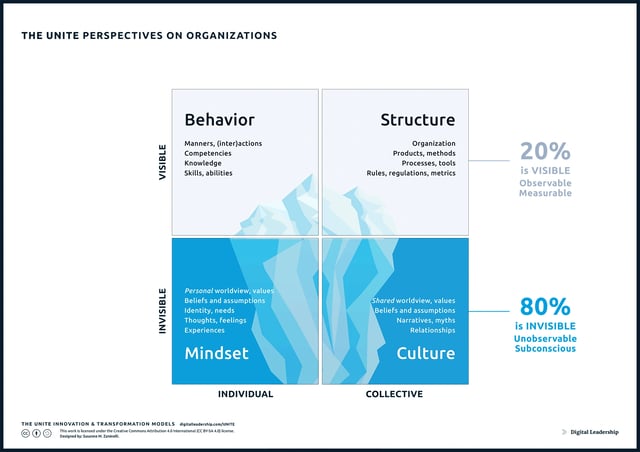
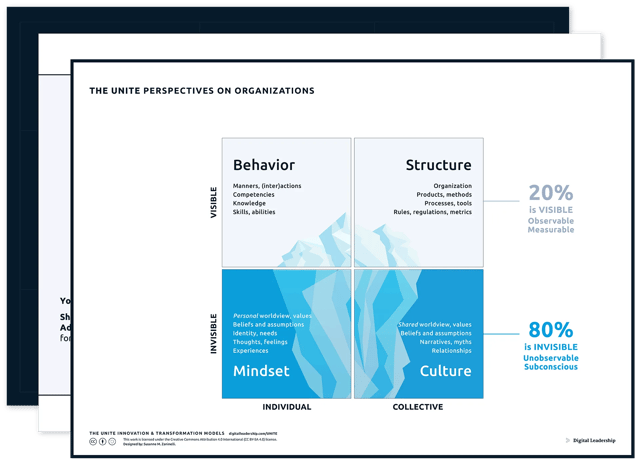
This graphic visualizes the idea that the majority of your culture (80%) is not visible, but comes from the individual and collective beliefs, values, self-understandings, perceptions and feelings of your employees. Companies often try to change culture by working with the 20% of visible culture that we can see–knowledge, skills, rules, processes. But these changes can’t take hold if they are not supported by changes in the deep structures of culture.
The mechanics
Culture, even in an organization, is generally divided into personal and collective. How do individual employees behave and what are the collective norms that the company follow? However, these visible aspects are supported and driven by both personal and collective subconscious values, perceptions and feelings. Just like an iceberg, the majority of culture is happening below the surface where we can’t see it and often don’t even know it exists. in order to change culture, therefore, we need to focus explicitly on these invisible drivers. By changing how the people in your company think, feel and perceive the world, you can create the foundation for a truly innovative company culture.
The purpose
What is the goal of the model?
Lasting change. Everyone knows that culture is the key to innovation, yet most companies cannot build the type of culture they want and need. That is because they are focusing their efforts in the wrong place. By focusing on the invisible drivers of culture, we can allow an innovation culture to emerge organically from a change in mindset.
Beyond the download
The PDF is yours to keep. But a model changes something only when it touches the work — and that is what Axibra does with it. The model becomes the structure your decisions are made in, and every outcome stays traceable back to the input it came from.
In practice
For years we applied this model by hand, in client engagements. It now runs inside Axibra.
Culture is the first reason transformations fail. Axibra keeps the organizational side of a decision in view instead of leaving it to chance.
See how it worksThousands of organizations leverage the UNITE models — these are some of them …













By subject

From here on
Axibra is where these models run. It carries a decision through to the work that follows it, and keeps every result traceable back to the input it came from. If you would rather start with a conversation, we are one call away.
Strategy does not fail in the thinking. It fails in the handover.
Stefan F. DieffenbacherFounder & Managing Director of Digital Leadership