Culture and organization
Culture is the first reason transformations fail. Axibra keeps the organizational side of a decision in view instead of leaving it to chance.
See how it worksThis ambidextrous org-chart demonstrates how an organization might organize around the 3 Horizons of Growth, catering to both the existing core organization, but also focusing on innovation and transformation.
The package
The case
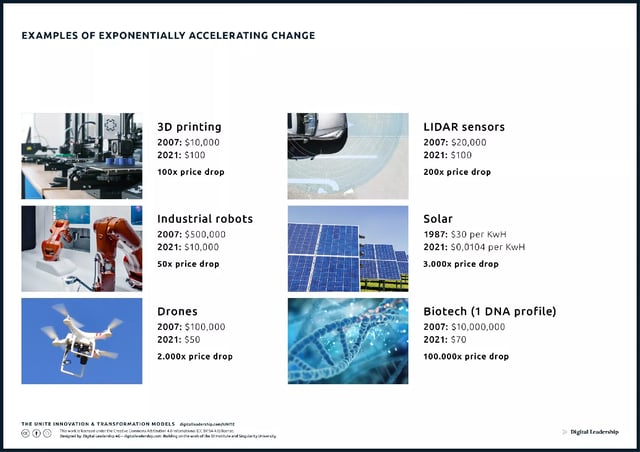
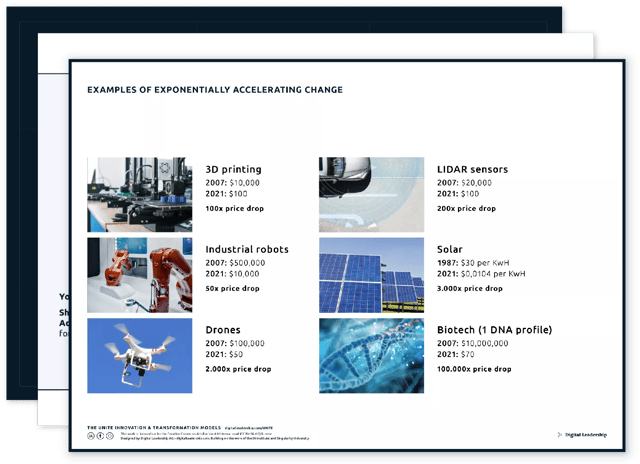
Most growth is driven by innovation, but what is driving the accelerating growth that we see? This graphic helps us understand why the past 15 years have moved us forward at an unprecedented pace. These concrete examples demonstrate why we have to innovate to stay ahead of the game.
The mechanics
One of the dominant features of the economy over the past 50+ years has been a massive growth in computing power. To understand the exponential evolution of computing power we can look to Moore’s law, the idea that computing performance doubles every two years while costs remain the same. As these technologies drop in price, they shape entire markets. Thus when you are thinking about the near and medium future, think about how the external environment, and particular technologies on an exponential path, will shape the environment you are operating in. But Moore’s law extends to more than just microchips. Many other technologies are following a similar path of exponential evolution. Here we see six such technologies: 3D printing, industrial robots, drones, LIDAR sensors, solar panels, and genome sequencing. We can see that between 2007 and 2017, the price of such technologies dropped dramatically (DNA sequencing has fallen in price by a factor of 100,000!), while the quality has stayed the same or, in many cases, improved.
The purpose
What is the goal of the model?
Planning ahead: Technologies are changing rapidly and dragging the rest of human society with them. If you don’t plan to be ahead of the curve, your business will be left behind. However, if you can envision the ways in which accelerating technologies will shape the markets of the future, you may be able to capitalize on a blue ocean.
Beyond the download
The PDF is yours to keep. But a model changes something only when it touches the work — and that is what Axibra does with it. The model becomes the structure your decisions are made in, and every outcome stays traceable back to the input it came from.
In practice
For years we applied this model by hand, in client engagements. It now runs inside Axibra.
Culture is the first reason transformations fail. Axibra keeps the organizational side of a decision in view instead of leaving it to chance.
See how it worksThousands of organizations leverage the UNITE models — these are some of them …













By subject

From here on
Axibra is where these models run. It carries a decision through to the work that follows it, and keeps every result traceable back to the input it came from. If you would rather start with a conversation, we are one call away.
Strategy does not fail in the thinking. It fails in the handover.
Stefan F. DieffenbacherFounder & Managing Director of Digital Leadership