Tools & Models

Porter’s Value Chain Model

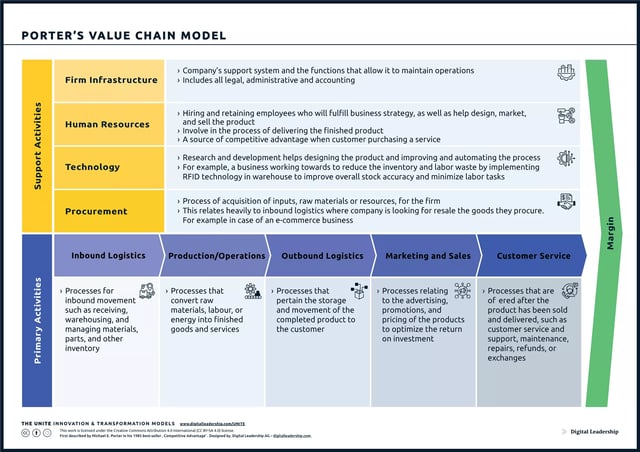
Porter’s Value Chain Model ist ein Framework, mit dem sich die internen Prozesse und Aktivitäten eines Unternehmens analysieren lassen, um Bereiche zu identifizieren, in denen sich Wert schaffen und Kosten senken lassen. Als Werkzeug der Unternehmensstrategie hilft es dabei, die Quellen der Wertschöpfung in einem Unternehmen zu verstehen und zu erkennen, wie dieses Unternehmen seine Wettbewerbsfähigkeit verbessern kann. Das Modell trennt die primären Aktivitäten und die unterstützenden Aktivitäten, die ein Unternehmen ausführt, um ein Produkt oder eine Dienstleistung an seine Kunden zu liefern.

Porter’s Value Chain Model
4We have compiled all models in easy-to-use PDF format

The package

What the download contains

  1. Hilft dabei, die Geschäftsaktivitäten so zu strukturieren, dass sich jede Einzelne hinsichtlich Kosten und Wert bewerten lässt
  2. Führt die Einteilung in primäre Aktivitäten und unterstützende Aktivitäten ein

The case

Why we use it

Zu verstehen, auf welche unterschiedlichen Weisen ein Unternehmen seine begrenzten Ressourcen einsetzt, kann eine erhebliche Herausforderung sein. Porter’s Value Chain Model versucht, diesen Prozess zu erleichtern, indem es alles, was ein Unternehmen tut, in zwei Körbe einteilt: primäre Aktivitäten und sekundäre Aktivitäten. Dem Modell zufolge umfassen die primären Aktivitäten die gesamte Arbeit und Investition, die das Unternehmen aufbringen muss, um seinen Kunden Wert zu liefern. Zu den primären Aktivitäten zählen: 1. Eingangslogistik 2. Produktion 3. Ausgangslogistik 4. Marketing und Vertrieb 5. Service. Die sekundären Aktivitäten in Porter’s Value Chain Model sind: 1. Beschaffung 2. Technologieentwicklung 3. Personalmanagement 4. Unternehmensinfrastruktur.

The mechanics

How It Works

Porter’s Value Chain Model schlüsselt sämtliche Geschäftsaktivitäten in diesen Schritten auf: 1. Identifizieren Sie die primären und unterstützenden Aktivitäten in Ihrer Wertschöpfungskette (z. B. Beschaffung, Personalmanagement). 2. Bewerten Sie Kosten und Wert jeder Aktivität: Beurteilen Sie die Kosten jeder Aktivität und den Wert, den sie zum Produkt oder zur Dienstleistung beiträgt. 3. Identifizieren Sie Verbesserungsbereiche auf Basis der Kosten-Wert-Analyse. 4. Entwickeln Sie einen Aktionsplan, um Änderungen an der Wertschöpfungskette umzusetzen. 5. Setzen Sie den Plan um und überwachen Sie die Ergebnisse.

The purpose

What is the goal of the model?

Das Ziel von Porter’s Value Chain Model ist es, Ihnen zu helfen, alle Aktivitäten zu verstehen, die die Ressourcen Ihres Unternehmens beanspruchen, und Bereiche mit Einsparpotenzial, Entwicklungsmöglichkeiten und Innovationschancen zu identifizieren.

What people say

Customers Reviews

4.8135 reviews

  • 5 star77%
  • 4 star13%
  • 3 star4%
  • 2 star2%
  • 1 star3%

View all 135 reviews

Richard Cobie, CEOReviewed on 15 July 2022

★★★★★Recommended as a purchase, worth the investment!

I completely re-evaluated the role of innovation in business growth: before reading this book I have to admit I thought it only entailed product new features and technologies enhancements, while now I see it has everything to do with meeting customer needs and uncovering a business USP, which automatically translates in sales! Could not recommend it more!

Janette Lavalier, Innovation Professor and ConsultantReviewed on 15 July 2022

★★★★★Recommended as a purchase, worth the investment!

Unlike most business innovation books I read over the last years (and even decades) when reading How to create innovation you immediately understand the authors have been there, innovating and transforming some of the world’s most amazing brands. Great work!

Karl Meckel, Change Development ManagerReviewed on 18 July 2022

★★★★★Recommended as a purchase, worth the investment!

Not only this book offers the most comprehensive innovation and business change overview but it really helps you take the next step, driving you step by step from theory to practice (also with super useful background notes and driving questions)

Franz Hellstrom, Head of CultureReviewed on 2 Aug 2022

★★★★★Recommended as a purchase, worth the investment!

I really enjoyed the whole book, but mostly the culture chapter, mainly because I always failed to acknowledge its major role in favouring or inhibiting business growth. Loved the graphics that helped connect all the dots in a visually appealing (and way easier) way.

Satoru Fukuda, Chief Strategy OfficerReviewed on 13 Aug 2022

★★★★★Recommended as a purchase, worth the investment!

We’been willing to innovate our business for some years now, but then we always got stuck before we even started, because basically we had no idea where to start…This book helped us do just that: find the right starting point with guiding questions and an incredibly comprehensive innovation overview.

Work with the inventors

Need help to apply The UNITE Models and Tools to your organization?

Work with the inventors. Building on a wealth of experience. Increase your competitive advantage and work with industry thought leaders. We are here to help.

In practice

Services in which we apply this model

We successfully apply the models we created in our services

Innovation

We support organizations to grow their innovation capability globally.

Learn more

Customer Experience

We will help you better understand your customer and create more enganging product and service experiences.

Learn more

Digital Transformation

The key is bridging the infamous strategy-execution gap. We enable organizations to execute a transformation successfully.

Learn more

Thousands of organizations leverage the UNITE models — these are some of them …

Stefan F. Dieffenbacher

Every day

Need help with your project?

We at Digital Leadership work on Innovation and Transformation related projects every day. Reach out do discuss how we can support you!

We build digital winners. It’s what we are made for. Let’s create winning digital businesses – together.

Stefan F. DieffenbacherFounder & Managing Director of Digital Leadership

The Strategy-to-Outcome Platform

Talk to us.

The first meeting is a working session, not a pitch.