The Empathy Map model is a tool used in design thinking to help businesses understand the needs, desires, and behaviors of their target customers. The Empathy Map model is a useful tool for businesses looking to improve their customer experience, develop new products, or expand into new markets.
The package
The case
The Empathy Map model is a valuable tool for businesses to gain insights into their customers' needs, desires, and behaviors. It helps to create products, services, and experiences that are more effective and user-friendly, leading to increased engagement, satisfaction, and loyalty. It encourages collaboration and empathy within the organization, leading to new ideas and insights that might not have emerged otherwise. It is widely used in product development, marketing, and customer experience design to create more customer-centric solutions.
The mechanics
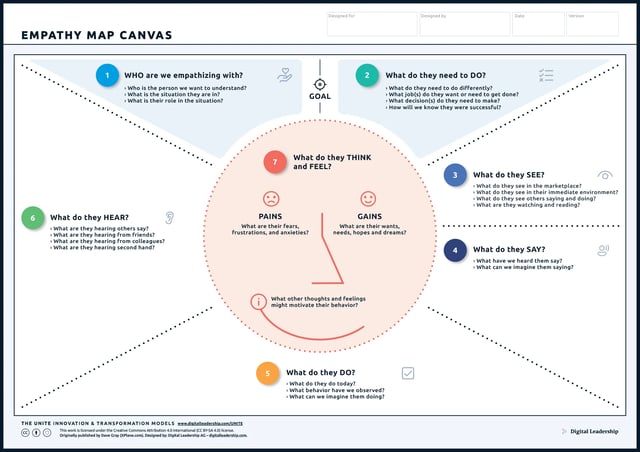
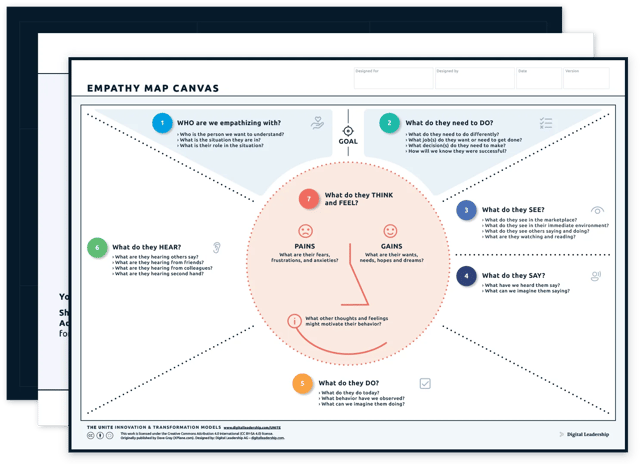
The Empathy Map model works by analyzing the customer's behavior, thoughts, feelings, and other key factors. The model consists of a visual representation of the customer's experience, including what they see, hear, think, feel, say, and do. By analyzing these factors, businesses can gain a deeper understanding of their customers' needs and tailor their products or services to better meet those needs. The seven sections of the Empathy Map lead you through a series of questions to ensure you consider your customers more deeply than we usually do. The process involves collaboration with stakeholders, including designers, marketers, and customer service representatives, to ensure that everyone is aligned around the customer's needs and focused on delivering a high-quality experience. The insights gained through the empathy mapping process can lead to new ideas and insights that can inform product development, marketing, and customer experience design.
The purpose
What is the goal of the model?
Empathy Map model's goal is to gain customer insights and foster empathy within organizations to create effective and user-friendly solutions.
Beyond the download
The PDF is yours to keep. But a model changes something only when it touches the work — and that is what Axibra does with it. The model becomes the structure your decisions are made in, and every outcome stays traceable back to the input it came from.
Thousands of organizations leverage the UNITE models — these are some of them …













By subject

From here on
Axibra is where these models run. It carries a decision through to the work that follows it, and keeps every result traceable back to the input it came from. If you would rather start with a conversation, we are one call away.
Strategy does not fail in the thinking. It fails in the handover.
Stefan F. DieffenbacherFounder & Managing Director of Digital Leadership