
Stefan F. Dieffenbacher
Founder & CEO
Working with some of the largest global companies in the world, Stefan is a highly recognized industry thought leader in innovation & transformation.
Tools & Models/Value Proposition
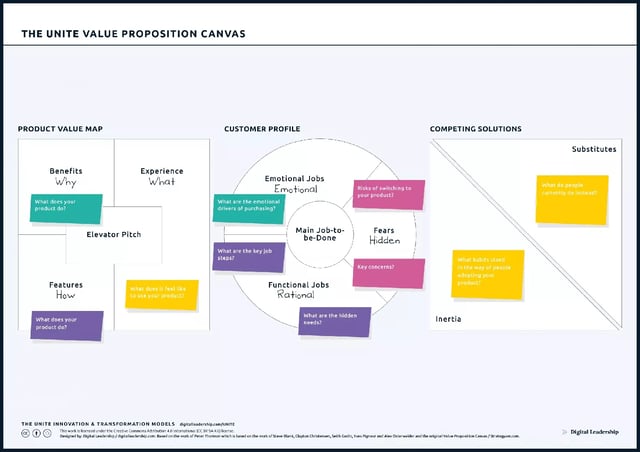
The Value Proposition Canvas provides a framework that centers your customers. It supports understanding the problem your customer is truly trying to solve so that you can design an elegant and effective solution. FREE DOWNLOAD Proudly shared open source
The authors
Founder & CEO
Working with some of the largest global companies in the world, Stefan is a highly recognized industry thought leader in innovation & transformation.

Partner Brand & Experience Design
Caroline is a veteran brand & experience leader who’s led design experience with some of the most respected brands in the marketplace.
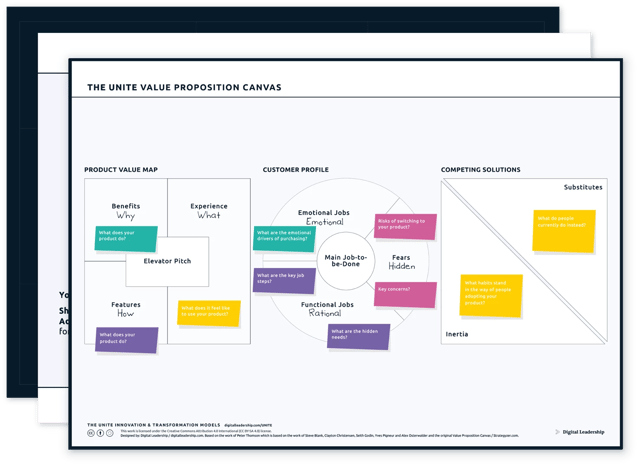
The package
The case
Many people begin innovation with a product but discover when they launch that no one wants or needs what they have created. Through the Jobs-to-be-Done (JTBD) framework, we center the customer’s needs and ensure that the product/solution you design will respond to a specific job they need to get done.
The mechanics
The Value Proposition Canvas has three sides. The Customer Profile in the center of the canvas allows you to get into your customer’s head and thus clarify their Job to be Done from both functional and psychological perspectives. The Product Value Map on the left helps you define how you intend to create value for that customer given their unmet needs. The ultimate objective is to achieve fit between the Customer Profile and the Product Value Map. You have achieved that fit once the product solves a clear Job to be Done. The Substitutes section outlines what people are currently using to solve their Job to be Done and identifies inertias and obstacles that might prevent them from switching, even if your solution is superior. Your product is competing against other products that meet customers’ deeper needs in entirely different ways. Gaining a customer means not only offering a superior solution but overcoming their resistance to trying something new.
The purpose
What is the goal of the model?
That’s easy: A happy customer. Happy customers ensure your company’s success, and you make customers happy by providing a solution to a problem that they need solved. This can only be achieved by placing the customer at the center of the process, understanding their needs and iterating your product until it perfectly meets their needs.
Beyond the download
The PDF is yours to keep. But a model changes something only when it touches the work — and that is what Axibra does with it. The model becomes the structure your decisions are made in, and every outcome stays traceable back to the input it came from.
In practice
For years we applied this model by hand, in client engagements. It now runs inside Axibra.
Axibra helps organizations grow their innovation capability — across the whole company, not in one team.
See how it worksAxibra helps you understand your customers better and design products and services people actually want to use.
See how it worksAxibra closes the infamous gap between strategy and execution, and carries a transformation through to delivery.
See how it worksThousands of organizations leverage the UNITE models — these are some of them …













Go further
The following tools and models support the one you are exploring. If you’re ready to go further, check them out. Download the models below and continue your journey …
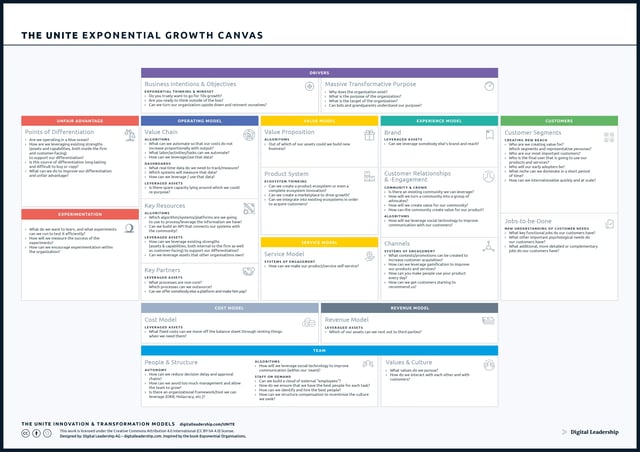
Business Model
The UNITE Exponential Growth Canvas allows you to accelerate or even create exponential growth by including a unique set ...
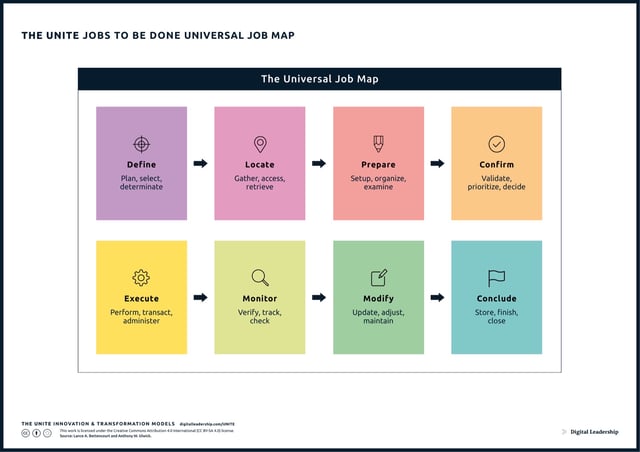
Customer needs / JTBD
The Jobs-to-be-Done Statement and Map put the job your customer is hiring your product for at the centre of the work …
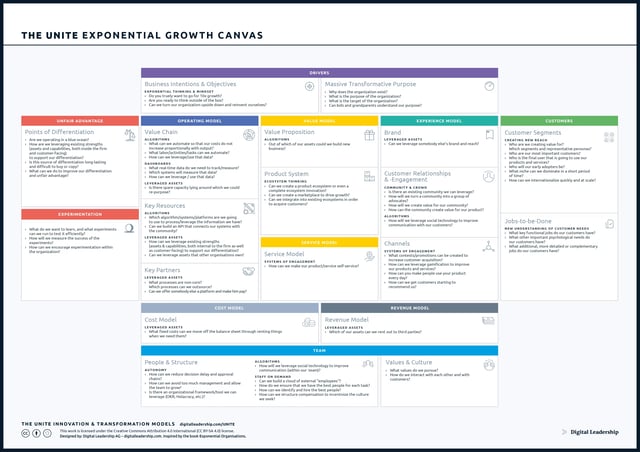
Business Model
A product is only as good as the Business Model (BM) that supports it, and creating an innovative product requires an equally innovative BM.
By subject

From here on
Axibra is where these models run. It carries a decision through to the work that follows it, and keeps every result traceable back to the input it came from. If you would rather start with a conversation, we are one call away.
Strategy does not fail in the thinking. It fails in the handover.
Stefan F. DieffenbacherFounder & Managing Director of Digital Leadership