
Stefan F. Dieffenbacher
Founder & CEO
Working with some of the largest global companies in the world, Stefan is a highly recognized industry thought leader in innovation & transformation.
Tools & Models/Understanding Context
You don’t create Value Propositions or Business Models in a vacuum. This critical canvas helps you understand the larger context in which you are operating.
The authors
Founder & CEO
Working with some of the largest global companies in the world, Stefan is a highly recognized industry thought leader in innovation & transformation.

Corporate Executive
A deal-making expert having led significant M&A transactions; business leader having built and led significant H1 and H2 businesses with portfolio values above £8bn; innovator who likes to re-imagine the world we live in having successfully launched a global EdTech.
The package
The case
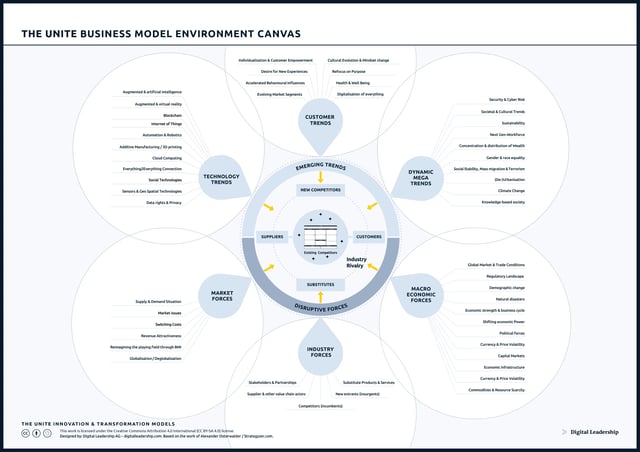
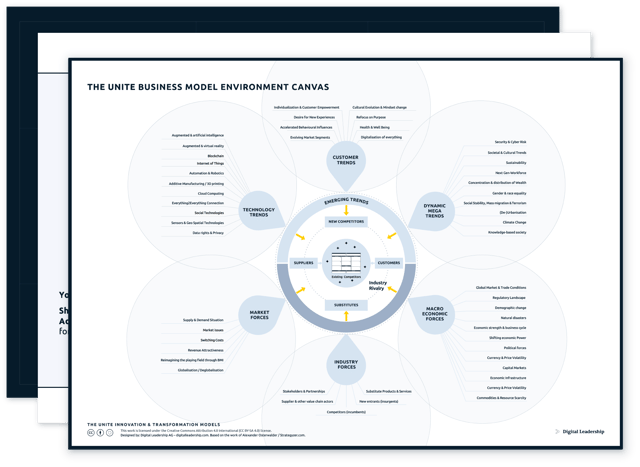
You don’t innovate in a vacuum. Understanding the larger context in which you want to operate is crucial. This canvas allows you to visualize the different aspects of your business environment. Just as the Extended Business Model Canvas creates another layer beyond your Business Model, this expands your view even further to understand the external world you are operating in.
The mechanics
The Business Model Environment tool is organized into two key areas: emerging trends and disruptive forces. These areas surround the Business Model Canvas because they are the factors influencing the Business Model you design. Unlike the Business Model itself, over which you have full control, external forces represent design constraints that you have to work with. Using it is simple: Basically, you get to play the “what if?” game. Go through each of the areas and simply ask yourself the tough questions. For example, in the societal and cultural trends: “How is this key technology trend affecting us?” Or with regards to regulatory trends: “What will change when this new rule/legislation comes into effect?” Understanding the design constraints on your Business Model is becoming even more important as the rate of change accelerates. If you don't have a strong sense of the ways that your context is changing, you will not be able to anticipate and adapt fast enough to keep your business afloat.
The purpose
What is the goal of the model?
Clarity on your operating context. The UNITE Business Model Environment Canvas will allow you to describe and analyze the design constraints for your business and identify opportunities for innovation in that environment.
Beyond the download
The PDF is yours to keep. But a model changes something only when it touches the work — and that is what Axibra does with it. The model becomes the structure your decisions are made in, and every outcome stays traceable back to the input it came from.
In practice
For years we applied this model by hand, in client engagements. It now runs inside Axibra.
Axibra helps organizations grow their innovation capability — across the whole company, not in one team.
See how it worksAxibra closes the infamous gap between strategy and execution, and carries a transformation through to delivery.
See how it worksCulture is the first reason transformations fail. Axibra keeps the organizational side of a decision in view instead of leaving it to chance.
See how it worksThousands of organizations leverage the UNITE models — these are some of them …













Go further
The following tools and models support the one you are exploring. If you’re ready to go further, check them out. Download the models below and continue your journey …
Strategy
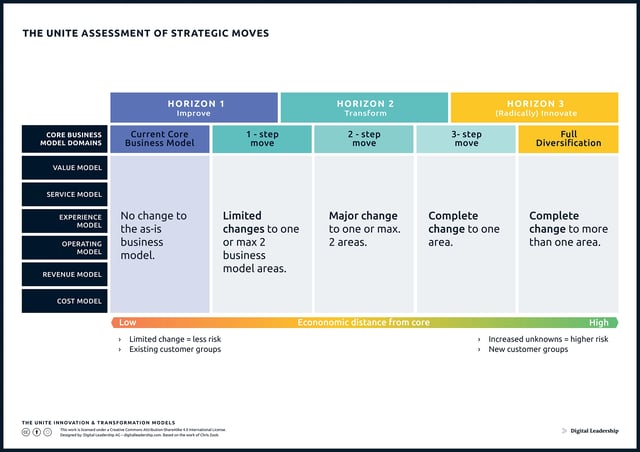
The Assessment of Strategic Moves shows us that risks increase with additional steps away from the current economic core ...
Value Proposition
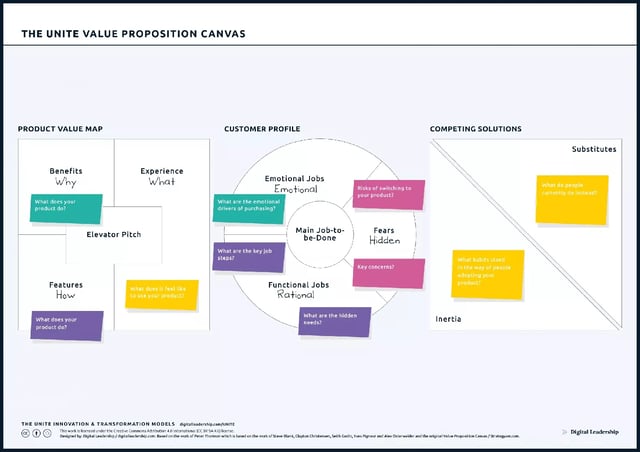
The Value Proposition Canvas provides a framework that centers your customers. It supports understanding the problem your customer is truly trying to solve so that…
Business Model
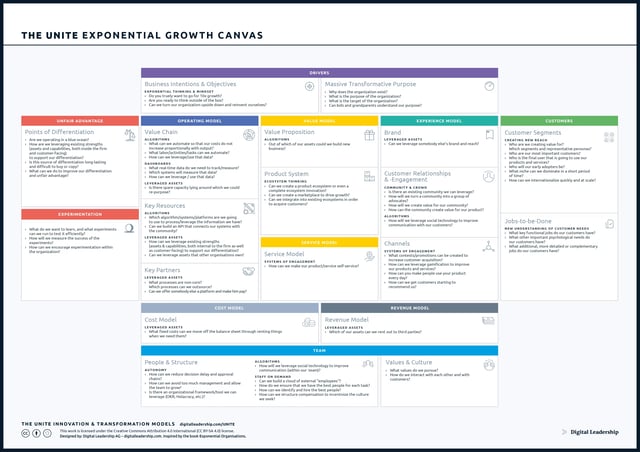
A product is only as good as the Business Model (BM) that supports it, and creating an innovative product requires an equally innovative BM.
By subject

From here on
Axibra is where these models run. It carries a decision through to the work that follows it, and keeps every result traceable back to the input it came from. If you would rather start with a conversation, we are one call away.
Strategy does not fail in the thinking. It fails in the handover.
Stefan F. DieffenbacherFounder & Managing Director of Digital Leadership