
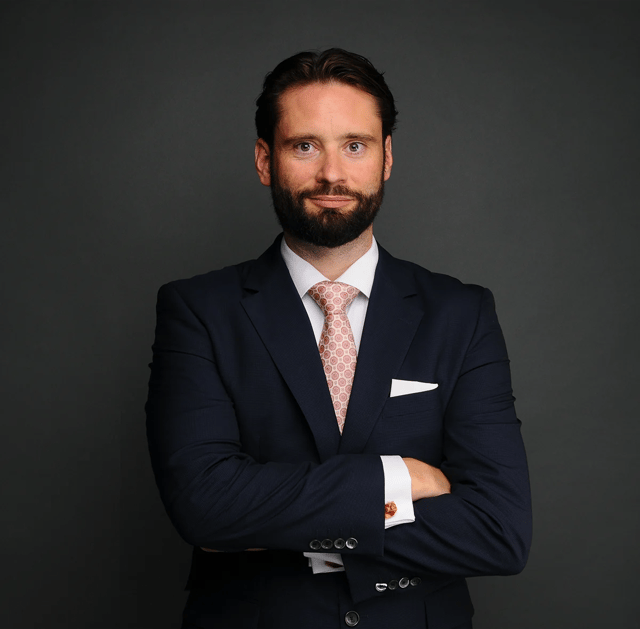
Stefan F. Dieffenbacher
Founder & CEO
Working with some of the largest global companies in the world, Stefan is a highly recognized industry thought leader in innovation & transformation.
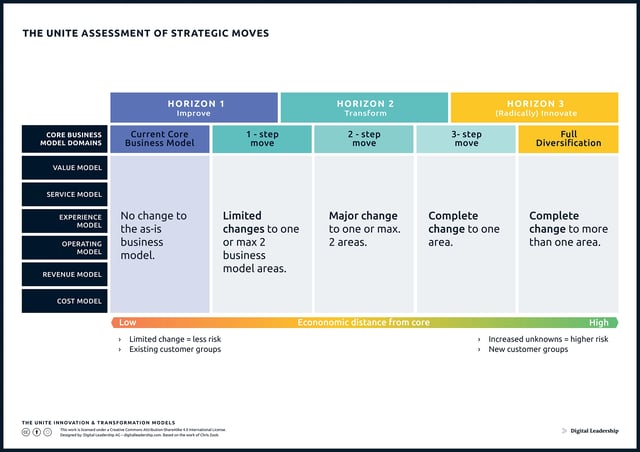
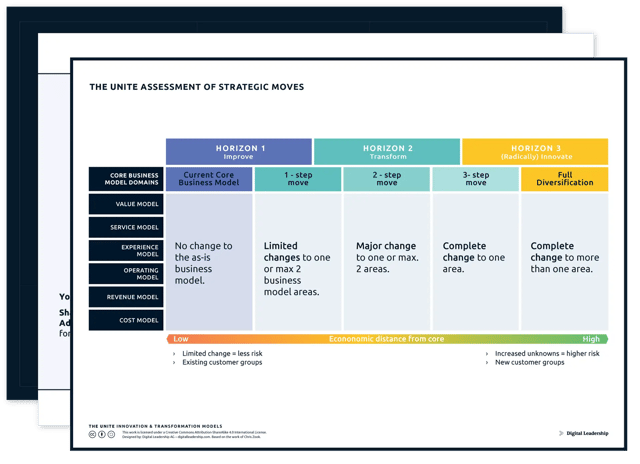
The Assessment of Strategic Moves shows us that risks increase with additional steps away from the current economic core of an organization. Leverage this tool to think about which steps you are making and how far afield you are going from your core.
The authors
Founder & CEO
Working with some of the largest global companies in the world, Stefan is a highly recognized industry thought leader in innovation & transformation.

Corporate Executive
A deal-making expert having led significant M&A transactions; business leader having built and led significant H1 and H2 businesses with portfolio values above £8bn; innovator who likes to re-imagine the world we live in having successfully launched a global EdTech.
The package
The case
When considering ways to stay ahead of the curve and future proof your business, the question often arises, “How innovative do we need to be?” The surprising answer is – not very. The history of corporate transformation demonstrates that you do not have to go far afield to uncover effective ways to innovate. You are more likely to be successful if you seek change in your own backyard. We use the Assessment of Strategic Moves to think about the risks and rewards of moving farther afield.
The mechanics
While the pay off from radical transformation can be bigger, it is inherently riskier because increasing complexity and more unknown factors decrease the odds of success. Conversely, the closer you stay to your core, the higher your probability of a successful transformation. Thus, an expansion strategy should be based on a series of moves into adjacent areas away from, but related to, the core business, such as new product lines or new distribution channels. These sequential moves carry less risk than diversification, yet they can create enormous competitive advantage, because they stem directly from what the company already knows and does best.
The purpose
What is the goal of the model?
Less risk, more reward. Your differentiating activities are the core of your business and your brand. The further you move away from them, the greater the risk of upsetting the balance of your organization. Therefore, the best approach for adapting to changing market conditions is to stick with most of what you have today—your existing customers, channels, capabilities, value creation setup, etc.—and to just move into adjacent areas as you see opportunities for solving a related problem in a new space.
Beyond the download
The PDF is yours to keep. But a model changes something only when it touches the work — and that is what Axibra does with it. The model becomes the structure your decisions are made in, and every outcome stays traceable back to the input it came from.
In practice
For years we applied this model by hand, in client engagements. It now runs inside Axibra.
Axibra helps organizations grow their innovation capability — across the whole company, not in one team.
See how it worksAxibra closes the infamous gap between strategy and execution, and carries a transformation through to delivery.
See how it worksThousands of organizations leverage the UNITE models — these are some of them …













Go further
The following tools and models support the one you are exploring. If you’re ready to go further, check them out. Download the models below and continue your journey …
Strategy
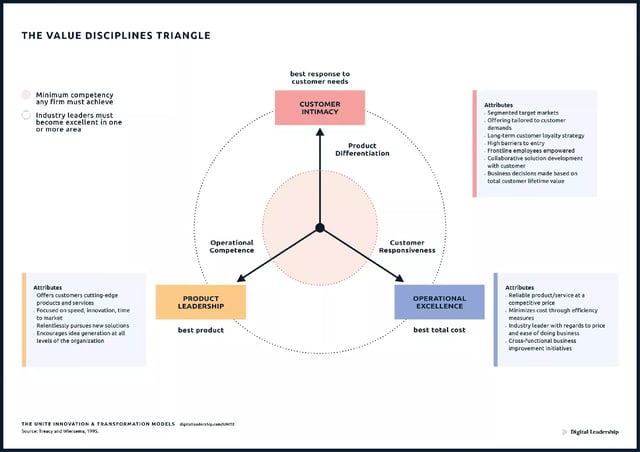
The Value Disciplines helps you and your team think about what quality your organization ultimately wants to stand for ...
Strategy
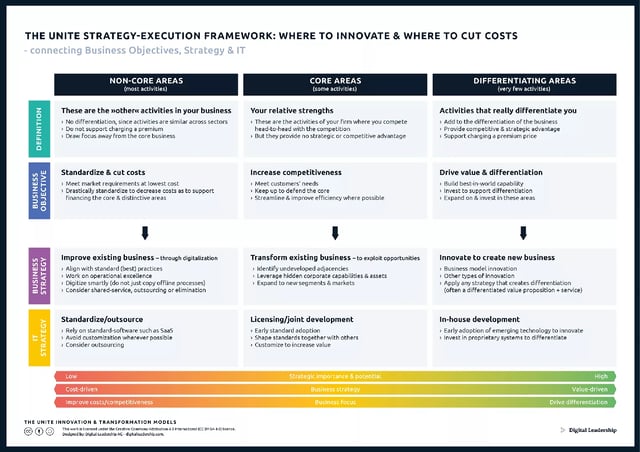
This ground-breaking framework helps you understand where to innovate and where to cut costs.
Business Model
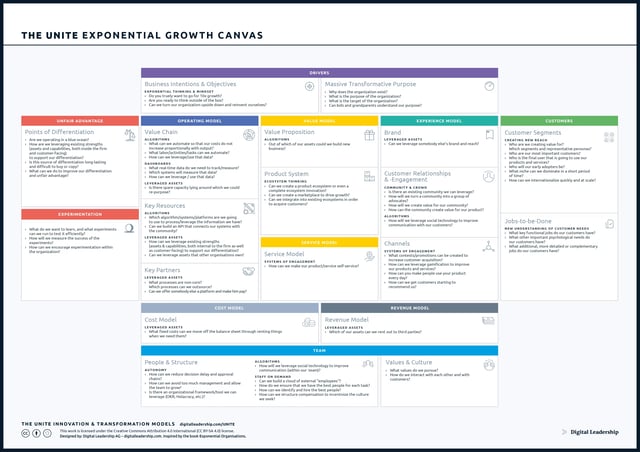
A product is only as good as the Business Model (BM) that supports it, and creating an innovative product requires an equally innovative BM.
By subject
From here on
Axibra is where these models run. It carries a decision through to the work that follows it, and keeps every result traceable back to the input it came from. If you would rather start with a conversation, we are one call away.
Strategy does not fail in the thinking. It fails in the handover.
Stefan F. DieffenbacherFounder & Managing Director of Digital Leadership