Digital transformation
Axibra closes the infamous gap between strategy and execution, and carries a transformation through to delivery.
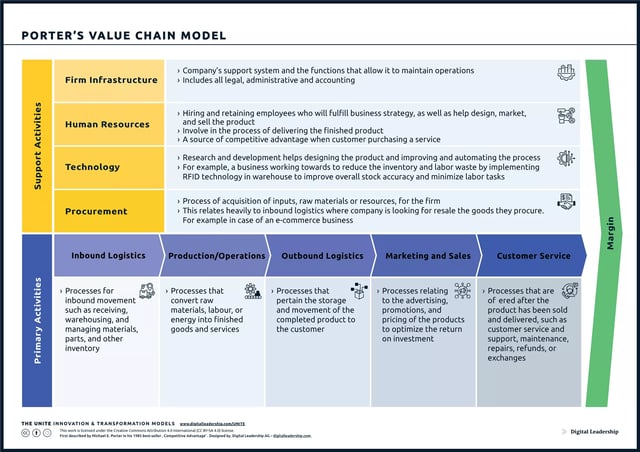
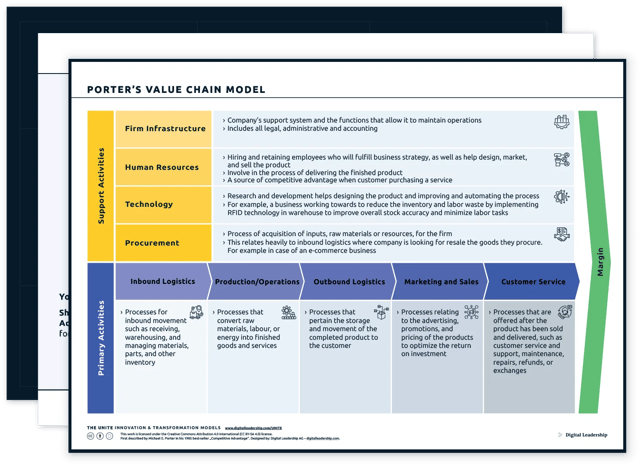
See how it worksPorter's Value Chain Model is a framework that helps analyze a company's internal processes and activities to identify areas where value can be added and costs can be reduced. As a tool for business strategy, it helps us understand the sources of value creation in a company and how that company can improve its competitiveness. The model separates primary and support activities that a company performs in order to deliver a product or service to its customers.
The package
The case
Understanding the diverse ways a business expends its limited resources can be a considerable challenge. Porter's Value Chain Model attempts to make this process easier by dividing everything a business does into two baskets: primary activities and secondary activities. According to the model, primary activities include all the work and investment necessary for the business to bring value to its customers. Primary activities include: 1. Inbound Logistics 2. Operations 3. Outbound Logistics 4. Marketing and Sales 5. Service The secondary activities in Porter's Value Chain Model are: 1. Procurement 2. Technology Development 3. Human Resource Management 4. Infrastructure
The mechanics
The Value Chain Model unpacks all of your business activities following these steps: 1. Identify the primary and support activities in your value chain (e.g., procurement, human resource management). 2. Assess the cost and value of each activity: Evaluate the cost of each activity and the value it adds to the product or service. 3. Identify areas for improvement, based on the cost and value analysis. 4. Develop an action plan for implementing changes to the value chain. 5. Implement and monitor.
The purpose
What is the goal of the model?
The Value Chain Model 's goal is to help you understand all the activities that occupy your business's resources and identify areas of potential savings, development, and innovation.
Beyond the download
The PDF is yours to keep. But a model changes something only when it touches the work — and that is what Axibra does with it. The model becomes the structure your decisions are made in, and every outcome stays traceable back to the input it came from.
In practice
For years we applied this model by hand, in client engagements. It now runs inside Axibra.
Axibra closes the infamous gap between strategy and execution, and carries a transformation through to delivery.
See how it worksThousands of organizations leverage the UNITE models — these are some of them …













By subject

From here on
Axibra is where these models run. It carries a decision through to the work that follows it, and keeps every result traceable back to the input it came from. If you would rather start with a conversation, we are one call away.
Strategy does not fail in the thinking. It fails in the handover.
Stefan F. DieffenbacherFounder & Managing Director of Digital Leadership