Digital transformation
Axibra closes the infamous gap between strategy and execution, and carries a transformation through to delivery.
See how it worksOnce you’ve used the Horizon 2 Digital Transformation process to make a step-change to your Business, you need to bring this innovation back into your core H1 business. This is where many transformation efforts fail. Follow the well-established 8-Step Process to successfully implement your innovation in the core organization.
The package
The case
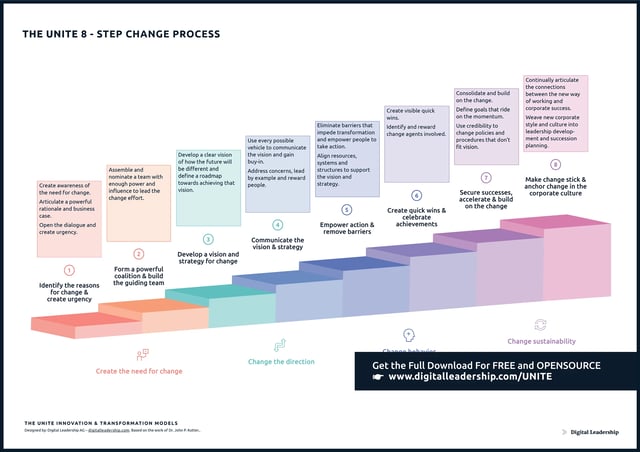
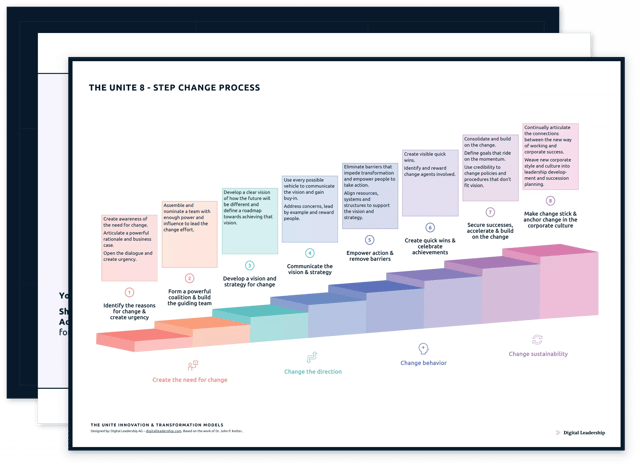
Prior to apply the step-change innovation back to your core business, you need to figure out your recipe for success. This is done by leveraging the H3 innovation process. The ultimate objective is to have your business- and operating model again perfectly aligned, which you importantly validate with an MVP approach. Once you are ready to start integrating the innovation back into your core organization, follow Kotter’s 8-step change process to bring your transformation into the company smoothly.
The mechanics
The change management process begins with creating urgency. Begin explaining to stakeholders why change is necessary. Then build a coalition. Bring together people who see the need for change and leverage them to build support in their own smaller groups. Third, create a vision for change. Link competing ideas about how to solve your problem into an overall vision that aligns with your company’s values. Then, crucially, you need to communicate your vision. Members of your organization are bombarded by a lot of information everyday. You need to make sure that your message is clear and compelling and communcated frequently. This will also allow you to identify people who might prove resistant to the change early on. Once you’ve identified people and other factors who might be obstacles, focus on eliminating those obstacles. Listen to those with concerns and see whether you can find a way to assuage them. Try to achieve some early successes, which will allow you to build momentum, and once you have achieved a critical mass of support, anchor the change in your company culture.
The purpose
What is the goal of the model?
A successful step-change transformation. Change is difficult because organizations are designed for stability and have an elaborate immune system that protects them from change. Your organization has spent vast amounts of time and energy optimizing its current business model, and they don’t want to throw that into chaos. But, at the same time, we know that if we don’t disrupt ourselves, someone else will do it for us. So staying where you are in times of significant change is a recipe for failure. That’s why change management has itself become a core competency. To put it provocatively: your ability to change might be more important than any other capability of your business. And alongside comes an organizational culture that supports change. That is what will keep your company ahead of the game in the long run.
Beyond the download
The PDF is yours to keep. But a model changes something only when it touches the work — and that is what Axibra does with it. The model becomes the structure your decisions are made in, and every outcome stays traceable back to the input it came from.
In practice
For years we applied this model by hand, in client engagements. It now runs inside Axibra.
Axibra closes the infamous gap between strategy and execution, and carries a transformation through to delivery.
See how it worksCulture is the first reason transformations fail. Axibra keeps the organizational side of a decision in view instead of leaving it to chance.
See how it worksThousands of organizations leverage the UNITE models — these are some of them …













By subject

From here on
Axibra is where these models run. It carries a decision through to the work that follows it, and keeps every result traceable back to the input it came from. If you would rather start with a conversation, we are one call away.
Strategy does not fail in the thinking. It fails in the handover.
Stefan F. DieffenbacherFounder & Managing Director of Digital Leadership