
Stefan F. Dieffenbacher
Founder & CEO
Working with some of the largest global companies in the world, Stefan is a highly recognized industry thought leader in innovation & transformation.
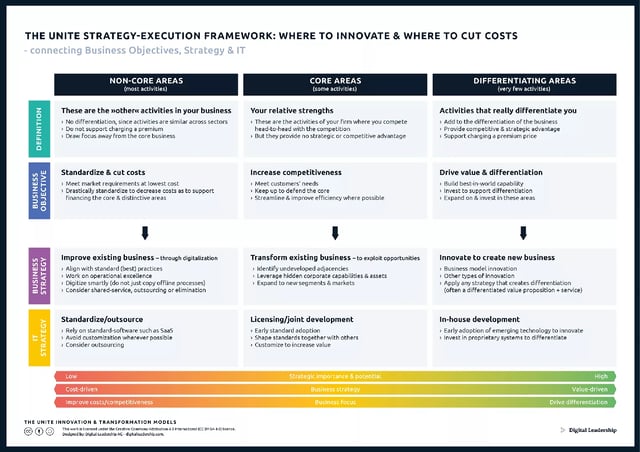
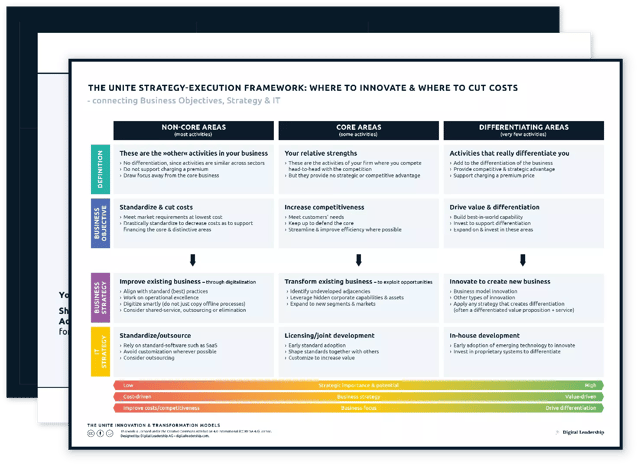
This ground-breaking framework helps you understand where to innovate and where to cut costs. It further helps you connect your strategy to your business objectives and your IT, thus aligning all critical business areas.
The authors
Founder & CEO
Working with some of the largest global companies in the world, Stefan is a highly recognized industry thought leader in innovation & transformation.

Partner for IT Strategy & Business Alignment
Adam is a seasoned transformation and digitization expert. He led major programs at the intersection of IT and business for international organizations
The package
The case
Most organizations do not understand what is non-core, core or differentiating in their business. This understanding is critical, since it drives key questions such as where to apply cost-cutting and where to innovate. Further, understanding whether something is core or not will help you understand which strategy to use and how to reach business and IT alignment.
The mechanics
The framework provides an overview of the non-core, core, and differentiating aspects of a business and connects them to matching Business Objectives, Business Strategies and IT strategies. You can see that as the differentiation potential increases, the strategic importance of the area increases, and decisions are driven by the desire to increase the value of your product. In the non-core areas, the strategic importance is lower, and these are places that you can cut costs through standardization, automation, and outsourcing. The core activities are where you are going head-to-head with your competition, so clearly you want to maintain the ability to compete. At the same time, these activities are not adding to your competitive advantage, so you want as much as possible to keep costs down here so that you can invest resources in differentiating activities. Typically, 80% of a business is non-core. Even if an activity refers to a key aspect of the business, like logistics or manufacturing, if you are not doing anything radically different than your competitors, this is not contributing to your differentiation. As such, the best strategy is to apply standard practices to optimize efficiency and reduce costs. Your differentiating areas, which are typically about 5% of your business, are what set you apart and allow you to charge premium prices. You should seek to become best in class in these activities and continue to develop your differentiation through innovation both in your product and in your Business Model.
The purpose
What is the goal of the model?
Strategy-Business-IT alignment and resource efficiency. As markets and mindsets change, it is not always clear what parts of your business are key to its success. It is important to consider all of the aspects of your Business Model to understand what is truly critical to your differentiation (and should be invested in) and what is not (and should be economized).
Beyond the download
The PDF is yours to keep. But a model changes something only when it touches the work — and that is what Axibra does with it. The model becomes the structure your decisions are made in, and every outcome stays traceable back to the input it came from.
In practice
For years we applied this model by hand, in client engagements. It now runs inside Axibra.
Axibra helps organizations grow their innovation capability — across the whole company, not in one team.
See how it worksAxibra closes the infamous gap between strategy and execution, and carries a transformation through to delivery.
See how it worksThousands of organizations leverage the UNITE models — these are some of them …











Go further
The following tools and models support the one you are exploring. If you’re ready to go further, check them out. Download the models below and continue your journey …
Transformation Approach
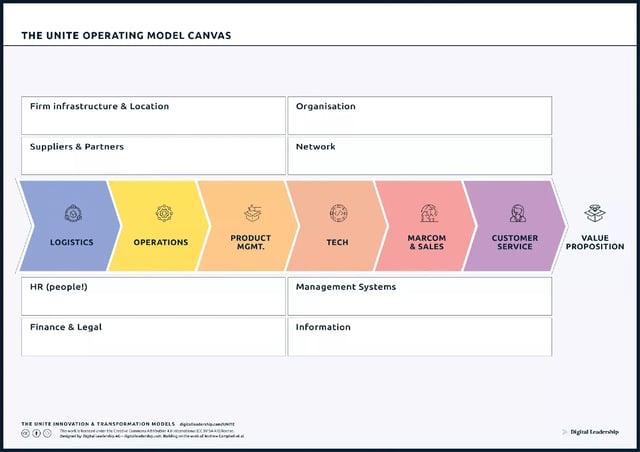
The UNITE Operating Model Canvas allows you to design your Operating Model purposefully, thinking about how each piece will support ...
Strategy
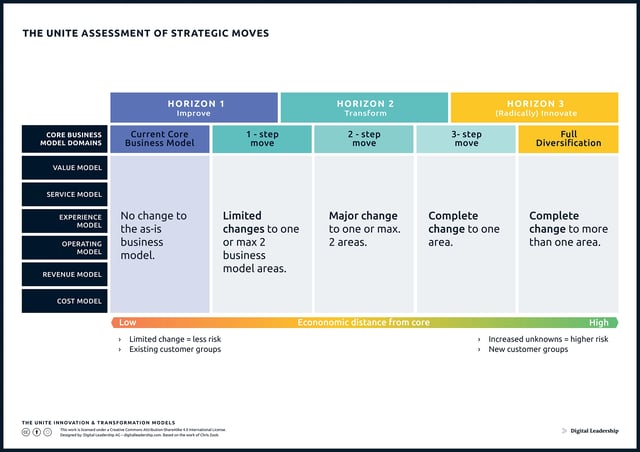
The Assessment of Strategic Moves shows us that risks increase with additional steps away from the current economic core ...
Business Model
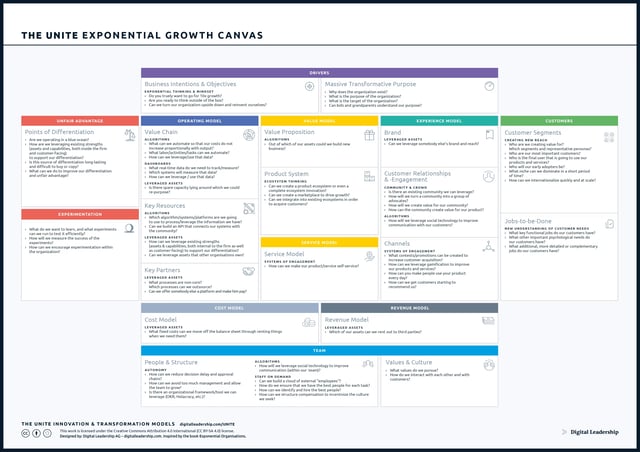
A product is only as good as the Business Model (BM) that supports it, and creating an innovative product requires an equally innovative BM.
By subject

From here on
Axibra is where these models run. It carries a decision through to the work that follows it, and keeps every result traceable back to the input it came from. If you would rather start with a conversation, we are one call away.
Strategy does not fail in the thinking. It fails in the handover.
Stefan F. DieffenbacherFounder & Managing Director of Digital Leadership