Innovation
Axibra helps organizations grow their innovation capability — across the whole company, not in one team.
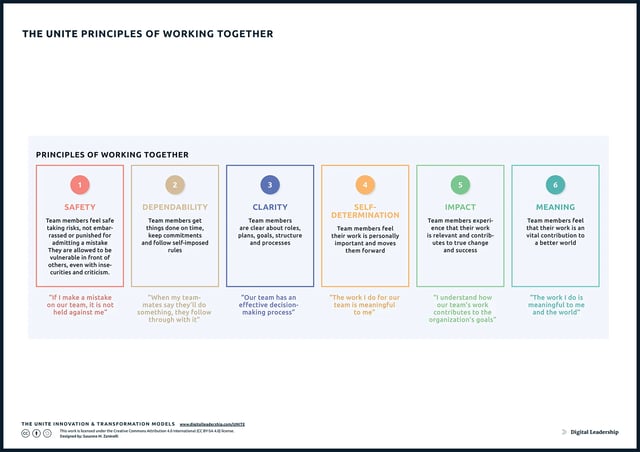
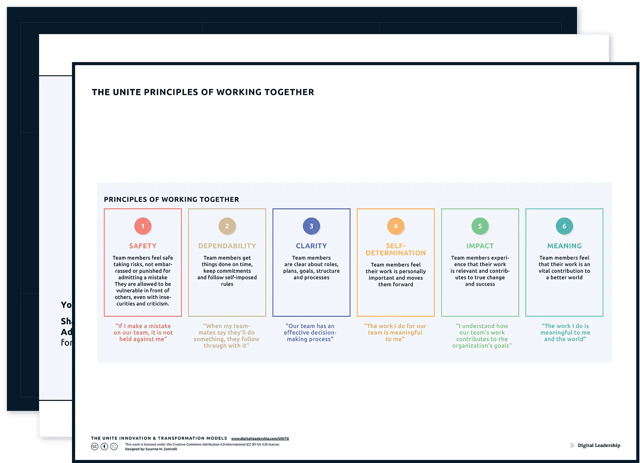
See how it worksThe UNITE Principles for successful Innovation Teams builds on Google’s Project Aristotle, which outlines the main things a team needs to thrive. We have set this work in context, tied the team’s work to the other layers of the culture model, and demonstrated how the principles align with the Mindset Spectrum.
The package
The case
As we think about creating a team culture that will promote innovation, we naturally think about values. What are the fundamental values that should serve as guidelines for how members of a team operate? This model, building upon Google’s five principles of flourishing teams, shows that we need to account for all of the aspects of the Mindset Spectrum when creating a comfortable and productive team. When we keep these guidelines in mind, it becomes easier to imagine rituals and processes that support them.
The mechanics
In 2012, Google embarked on a multiyear journey to discover the key factors contributing to a team’s success. They called the effort Project Aristotle, referring to the philosopher’s dictum that “the whole is greater than the sum of its parts.” Unsurprisingly, Google found that a thriving team had less to do with who was on it than with the atmosphere inside the team. They broke their conclusions into five basic categories. These categories map well onto the Mindset Spectrum. The most important principle is psychological safety. Do team members feel safe expressing their opinions, disagreeing with each other, and being themselves? Is there a punitive or an experimental ethos? After that comes dependability, clarity, meaningfulness, and impact. This demonstrates that none of the mindsets are better or worse than others. Instead, each is necessary to support the others. We’ve added “purpose” as the last principle because a teal mindset prioritizes not just that work gets done but that we are literally working on something purposeful.
The purpose
What is the goal of the model?
Creating a safe and productive team environment. It is always easier to build structures when simple principles guide you. This tool uses data-driven research to outline the hierarchy of needs in a group so that we can use these guidelines as we build our culture.
Beyond the download
The PDF is yours to keep. But a model changes something only when it touches the work — and that is what Axibra does with it. The model becomes the structure your decisions are made in, and every outcome stays traceable back to the input it came from.
In practice
For years we applied this model by hand, in client engagements. It now runs inside Axibra.
Axibra helps organizations grow their innovation capability — across the whole company, not in one team.
See how it worksAxibra closes the infamous gap between strategy and execution, and carries a transformation through to delivery.
See how it worksCulture is the first reason transformations fail. Axibra keeps the organizational side of a decision in view instead of leaving it to chance.
See how it worksThousands of organizations leverage the UNITE models — these are some of them …













By subject

From here on
Axibra is where these models run. It carries a decision through to the work that follows it, and keeps every result traceable back to the input it came from. If you would rather start with a conversation, we are one call away.
Strategy does not fail in the thinking. It fails in the handover.
Stefan F. DieffenbacherFounder & Managing Director of Digital Leadership